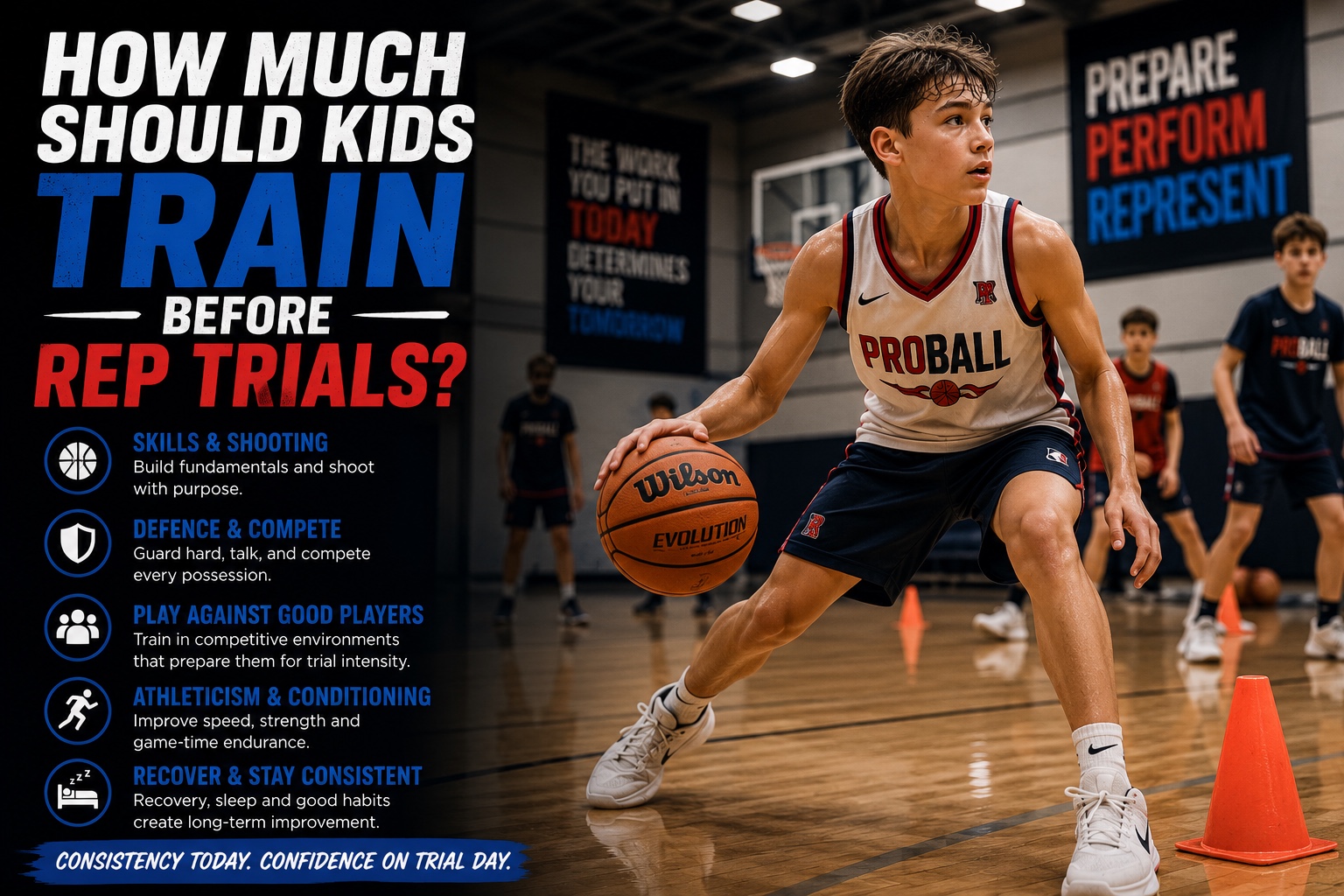
Rep trials have a funny way of creating panic. Trials are six weeks away and suddenly a young player who normally trains twice a week is doing basketball almost every day. Extra shooting. Private sessions. Team training. Strength work. More games. More everything.
Parents are trying to help. Players are trying to give themselves the best possible chance. But there’s a problem. You can’t cram for basketball trials like you cram for an exam.
The goal before rep trials isn’t to squeeze as much basketball as possible into the final few weeks. It’s to arrive prepared, confident, healthy and comfortable playing at intensity.
So how much should kids actually train before rep trials? Let’s break it down.
There Isn’t One Perfect Number
A 10-year-old trying rep basketball for the first time shouldn’t necessarily train like a 15-year-old who’s already played several seasons of representative basketball.
Age matters. Experience matters. Their current training load matters. How physically mature they are matters. School, sleep and other sports matter too. That’s why we’d be careful with anyone saying: “Every kid needs to train five days a week before trials.” They don’t.
For many young players, a good starting point is 2 to 4 quality basketball sessions per week, depending on their age, experience and what they’re already accustomed to. Some experienced players may comfortably do more. Some younger or newer players may need less. The important word is quality. Four tired, unfocused sessions aren’t automatically better than three excellent ones.
Start With What Your Child Already Does
This is probably the biggest mistake we see. A player normally trains twice a week. Rep trials get closer. Now they’re training six times. Their body hasn’t magically become prepared for three times the workload just because trials are coming. Increasing basketball gradually makes much more sense.
If your child currently trains once or twice per week, don’t suddenly throw them into basketball every day. Add exposure progressively. Give their body time to adapt. And watch how they’re responding.
How Often Should My Child Train Each Week?
We’ve covered normal weekly training in more detail there. Rep preparation changes the focus slightly, but the same principle remains. Consistency beats panic training.
What Should Rep Trial Training Actually Include?
This is where things get interesting. Parents often assume preparing for rep trials means: More skills training. Skills matter. Of course they do. But trials aren’t a dribbling exhibition.
Coaches are watching kids play basketball. Your child needs opportunities to practise skills under pressure, against defenders and while making decisions.
A good preparation week might include a mixture of:
- Skill development
- Shooting
- Competitive one-on-one and small-sided games
- Team basketball
- Defence
- Game-speed decision making
- Athletic movement
- Recovery
The closer trials get, the more important it becomes that training actually resembles basketball. Knowing fifteen dribble combinations isn’t much use if your child freezes when a defender pressures them.
Shooting Matters, But Don’t Just Chase Makes
It’s tempting before trials. “Let’s get 500 shots up every day.” Volume can help. But only when those repetitions are useful. Young players should work on shooting technique, footwork, balance and getting comfortable taking shots at game speed. They should also practise making the decision to shoot. That’s different.
During trials, your child might get one clean opportunity in several possessions. Can they recognise it? Can they take it confidently? Can they miss and keep playing? That’s basketball.
How Do Kids Become Better Shooters?
And if your child regularly passes up open shots because they’re worried about missing, there’s another problem worth addressing.
Why Is My Child Scared to Shoot?
Because adding another 300 uncontested shots won’t necessarily fix fear.
Defence Should Be a Huge Part of Rep Preparation
Here’s something young players sometimes don’t realise. You don’t need the ball to impress a coach. You can defend. Talk. Sprint back. Help a teammate. Box out. Compete. Stay engaged. Make the right rotation.
Rep trials contain a lot of players who want to show coaches what they can do offensively. That makes reliable defenders valuable. A player who competes defensively every possession gives coaches something they can trust.
If your child is preparing for trials, don’t spend every extra session shooting and dribbling. Teach them to enjoy guarding someone. That can separate them quickly.
Kids Need to Play Against Good Players
Rep trials feel fast because they are fast. Players are stronger. Closeouts happen quicker. Passing windows disappear. There’s less time to think.
One of the best ways to prepare for that environment is to experience it before trial day. That means competitive training matters.
Your child should have opportunities where they:
- Get pressured
- Lose the ball
- Guard good players
- Make mistakes
- Play through contact
- Make decisions quickly
- Recover after something goes wrong
That’s how the environment starts feeling normal. The first time your child experiences that intensity shouldn’t be when somebody hands them a trial number.
What Do Rep Coaches Actually Look For?
This is where parents sometimes overthink things. Yes, coaches notice talent. They notice size, speed and skill. But they’re also watching what happens between the obvious moments.
Does the player listen? Do they compete? Do they defend? Can they play with teammates? What happens after they make a mistake? Do they understand spacing? Do they sprint? Do they have good body language? Can they take coaching?
A player doesn’t need to dominate every possession to have a good trial. Sometimes trying too hard to impress actually makes a player look worse. They force shots. Over-dribble. Stop passing.
Try difficult moves. Then get frustrated when something doesn’t work. Good basketball still looks like good basketball.
What Do Rep Coaches Actually Look For?
That article goes much deeper into the trial itself.
Don’t Forget Athleticism
Basketball skills aren’t the whole picture. Rep basketball gets more physical as kids get older. Acceleration matters. Changing direction matters. Balance matters. Jumping matters. Being able to repeat high-intensity efforts matters.
But again, don’t panic. Eight weeks before trials isn’t the time to suddenly put a child through an extreme conditioning program.
Young athletes develop athleticism over time. Running, jumping, landing, changing direction and learning how to control their body all contribute.
More Training Isn’t Better If Your Child Is Exhausted
This matters. If your child starts looking flat, constantly sore, unusually irritable or completely unenthusiastic about basketball, piling another session onto the week probably isn’t the answer.
Kids still need recovery. They still have school. They need sleep. And they need days where basketball isn’t consuming their entire life.
You want your child walking into trials feeling sharp. Not surviving the final week of a six-week basketball boot camp. Recovery is part of preparation.
5 Things Your Child Should Do Before Bed After a Basketball Game.
What About the Week Before Rep Trials?
This is where we’d actually reduce the temptation to do more. Your child isn’t going to transform their basketball ability in seven days. But they absolutely can arrive tired. Keep them moving. Keep them shooting. Keep training competitive. But don’t suddenly add huge workloads.
The final few days should be about feeling good. Get some quality basketball in. Eat normally. Hydrate. Sleep. Then go trial. There’s nothing magical left to discover.
And the Day Before?
Don’t turn it into the NBA Combine. Seriously. A light shoot or normal session can be fine if that’s what your child is accustomed to. But they don’t need a three-hour workout. They don’t need 1,000 shots. They don’t need you reminding them every twenty minutes that tomorrow is the big day.
Let them be a kid. Pack what they need. Get organised. Eat. Sleep. Show up.
The Best Rep Trial Preparation Starts Months Before Trials
This is the part nobody loves hearing. The best way to prepare for rep trials isn’t a six-week program. It’s training consistently throughout the year. That’s where confidence comes from. Not motivational speeches the night before. Evidence.
Your child has trained. They’ve competed. They’ve defended good players. They’ve made shots. They’ve missed shots. They’ve had bad sessions and come back. They’ve been uncomfortable before. So when trials arrive, the environment doesn’t feel completely foreign. That’s preparation.
So, How Much Should Your Child Train?
There’s no universal number, but for many young basketball players: 2 to 4 quality basketball sessions per week can be a sensible range, adjusted for age, experience, current workload and recovery.
More experienced players may train more frequently if they’ve built up to it. But don’t obsess over the number. Ask better questions: Are the sessions good? Are they playing against defenders? Are they making decisions? Are they defending? Are they getting enough shooting repetitions? Are they recovering? Are they still enjoying basketball?
And most importantly: Have they been doing it consistently? Because rep trials rarely expose who trained hardest last week. They tend to expose what players have been building for months.
Preparing for Rep Basketball in Sydney?
At ProBall, young players can train regularly throughout the week, develop their skills and get more exposure to competitive basketball before representative trials arrive. The goal isn’t to panic-train kids before selections. It’s to help them become better basketball players throughout the year. Try ProBall Free for 4 Weeks. If your child wants to improve their basketball and prepare for the next level, come experience ProBall training for four weeks. Book your 4-week free trial and come train with us.
Book a Free Trial