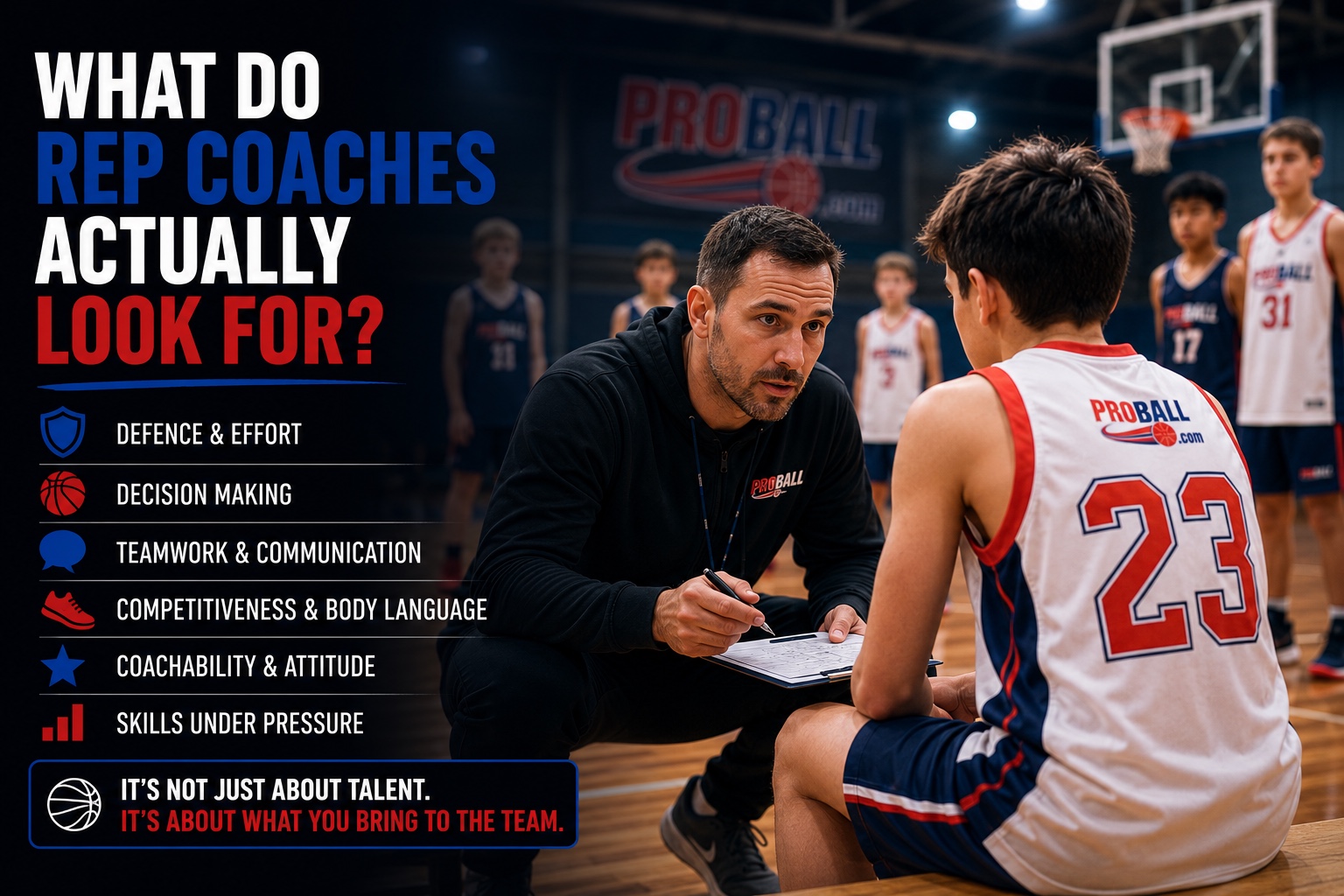
Parents usually notice the points. Coaches notice everything else. That’s one of the biggest misunderstandings around representative basketball trials.
A player walks off the court thinking they had a great trial because they scored 12 points. Another player goes home disappointed because they only scored four. But the coaches selecting the team might have rated the second player higher.
Why? Because rep coaches aren’t simply looking for the kids who score the most. They’re trying to build a basketball team. And those are two very different things.
First, what are rep coaches actually trying to do?
At a representative basketball trial, coaches aren’t necessarily choosing the five most talented individual players. They’re usually trying to build a squad that can play together. They need players who can handle the ball. Players who can shoot. Players who’ll defend. Players who understand spacing. Players who can make decisions. Players who can play different roles. And, importantly, players they believe they can coach.
That’s why trying to dominate every possession can actually work against a player. You don’t need to prove you’re the best player in the gym. You need to show that you can help a team win.
If you’re still learning how the representative pathway works, start with our guide to what representative basketball is.
1. Can you defend?
This is one of the easiest ways to stand out. Why? Because everyone wants the basketball. Far fewer players are excited about guarding someone.
Coaches notice the player who’s willing to pick up the opposition’s best guard. They notice who moves their feet instead of constantly reaching. They notice who helps a teammate. They notice who communicates. They notice who sprints back after a turnover.
You might go several possessions without touching the ball. You can still make an impression on every single one of them defensively. That’s powerful.
If your child wants to understand why coaches value this side of the game so much, read why defence is so important in basketball.
2. What do you do without the ball?
This separates players quickly. Young players often believe they can only impress a coach when they have the basketball. So they chase it. They call for it constantly. They stand around waiting for it. Or they try to create something every time they touch it.
Coaches are watching something different. What happens when you don’t have it? Do you cut? Do you create space? Do you screen? Do you communicate? Do you move the defence? Do you help your teammates get better opportunities?
Basketball is played with one ball and five players. That means most of your time is spent without it. Learn to impact those minutes and you become much more valuable.
3. How quickly do you make decisions?
At lower levels, players can catch the ball and think. At higher levels, that time disappears. Catch. Read. Decide. Shoot. Drive. Pass.
Great young players aren’t necessarily doing complicated things. They’re often just making simple decisions faster. That’s something coaches notice immediately. A player who constantly holds the basketball can slow an entire offence down. A player who makes quick, sensible decisions makes everyone around them better.
4. Can you actually shoot when you’re open?
Yes, shooting matters. But coaches aren’t necessarily looking for the child who takes the most shots. They’re looking for players who recognise good shots. Can you make an open shot? Can you shoot with balance? Can you recognise when you shouldn’t shoot? Can you make the extra pass? And perhaps most importantly, what happens after you miss?
Some players miss once and disappear. Others shoot the next open shot with exactly the same confidence. That’s valuable.
If shooting is one area your child needs to develop before trials, we’ve broken down how kids become better shooters and why purposeful repetitions matter more than simply taking hundreds of random shots.
5. How do you react after a mistake?
This one is huge. And parents often miss it completely. Turnovers happen. Shots miss. Players get beaten defensively. Coaches know that. They’re not expecting a perfect trial. What they’re watching is the next five seconds. Does the player drop their head? Look at their parents? Blame a teammate? Argue with the referee? Stop running? Or do they sprint back and make the next play?
You can learn an enormous amount about a player from what they do immediately after something goes wrong. Mistakes don’t necessarily hurt your trial. Your reaction to them can.
6. Are you coachable?
Imagine a coach stops a drill and gives a player one piece of feedback. Next possession, what happens? That’s the test.
A coachable player listens. Tries the adjustment. Maybe they don’t execute it perfectly. That’s okay. The coach can see they’re trying.
Compare that with a player who nods and immediately does exactly the same thing again. Talent matters. But coaches know they’re going to spend months working with these players. They want kids who want to learn.
7. What’s your body language saying?
You don’t have to scream. You don’t have to become the loudest kid in the gym. But body language matters. Coaches notice players who stay engaged. They notice players who encourage teammates. They notice players who run into huddles instead of slowly walking over.
And they notice the opposite. Eye rolls. Dropped shoulders. Frustration.Walking back on defence. Looking towards Mum or Dad after every mistake.
Young players often don’t realise they’re communicating even when they aren’t speaking. They are.
8. Can you play a role?
This is where talented players sometimes get caught out. Maybe your child scores 20 points every weekend for their local team. That’s great. But on a representative team, there might be three other players who can score 20 too.
Now what? Can they defend? Can they rebound? Can they move without the ball? Can they make an extra pass? Can they come off the bench and immediately bring energy? Can they contribute without being the centre of the offence?
The higher you go in basketball, the more important this becomes. The question changes from “How good are you?” to “How can we use you?”
9. Do you compete?
Coaches can teach shooting mechanics. They can teach defensive positioning. They can teach offensive concepts. It’s much harder to manufacture competitiveness.
That doesn’t mean screaming or playing aggressively. It means caring about the possession. Chasing the loose ball. Finishing the drill. Running back. Trying again after losing. Wanting to guard someone good.
Competing shows up in dozens of tiny moments. Coaches see them.
10. Are your skills ready for this level?
There’s no escaping this one. Mindset and effort matter enormously. But representative basketball is still competitive basketball.
Players need skills. They need to handle pressure. Finish. Pass. Defend.Shoot. Understand the game.And perform those skills at the speed the level demands.
That’s why preparing for representative basketball shouldn’t begin two weeks before trials. Development happens over months and years.
If you’re wondering what a sensible weekly training load looks like for a young player, read how often your child should train each week.
What coaches aren’t looking for
This deserves its own section because trials can make families do strange things. Your child doesn’t need to: Score every possession. Take every shot.Dribble through three defenders. Prove they’re better than everyone else.Play perfectly. Never make a mistake.
Trying too hard to stand out can sometimes make a player stand out for the wrong reasons. The goal isn’t: “Everyone needs to notice me.” A much better mindset is: “I’m going to make winning plays.” Those usually get noticed anyway.
What if nerves take over?
Completely normal. Trials matter to kids. They know they’re being evaluated. Suddenly an easy shot feels harder. A mistake feels bigger.
Some children become more aggressive under pressure. Others become incredibly cautious. They stop shooting. Stop attacking. Start trying not to make mistakes. That’s usually when they stop looking like themselves.
If that’s something you’ve seen in your child, our article on why children become scared to shoot explains what’s often happening underneath that hesitation.
The answer isn’t telling them: “Don’t be nervous.” They’re probably still going to be nervous. Instead, give them things they can control. Run hard. Defend. Communicate. Make the simple pass. Take the open shot. Respond well after mistakes. That’s a much easier job than trying to “make the team.”
What parents should say before rep trials
Keep this simple. Your child already knows the trial matters. They don’t need a motivational speech in the car park. They definitely don’t need: “You have to play well today.”
Try something closer to: “Compete. Be a good teammate. Listen to the coaches. Enjoy it.” Then let them play. Afterwards, don’t immediately conduct a performance review. Give them some space.
Rep trials are stressful enough without turning the drive home into another selection panel.
One bad trial doesn’t define a player
This matters. A child can play poorly and still be a good basketball player. A child can play brilliantly and still miss selection. Representative teams have limited places. Coaches have different needs. Positions matter.Team balance matters. Existing squads matter.
And yes, sometimes selections will disappoint you. That’s sport. Missing one team at 10, 12 or 14 years old doesn’t tell you where a child will eventually end up. What happens next matters far more...
Do they keep training? Do they learn? Do they come back? Do they still love basketball That’s development.
The player coaches remember
You don’t need to leave a rep trial having scored 20 points. Leave having competed. Leave having defended. Leave having listened. Leave having made teammates better. Leave having responded properly when something went wrong. Leave having shown your actual basketball ability instead of desperately trying to impress everyone. Because ultimately, rep coaches aren’t simply asking: “Who scored the most?” They’re asking:“Who can help us build the best team?” Become that player.
Help Your Child Get Rep Ready
Representative trials shouldn’t be the beginning of preparation. The work happens before them. At ProBall, young players can develop their shooting, ball handling, defence, decision-making and confidence through consistent basketball training. Whether representative basketball is the goal this year or further down the track, focus on building the player first.
Book a Free Trial