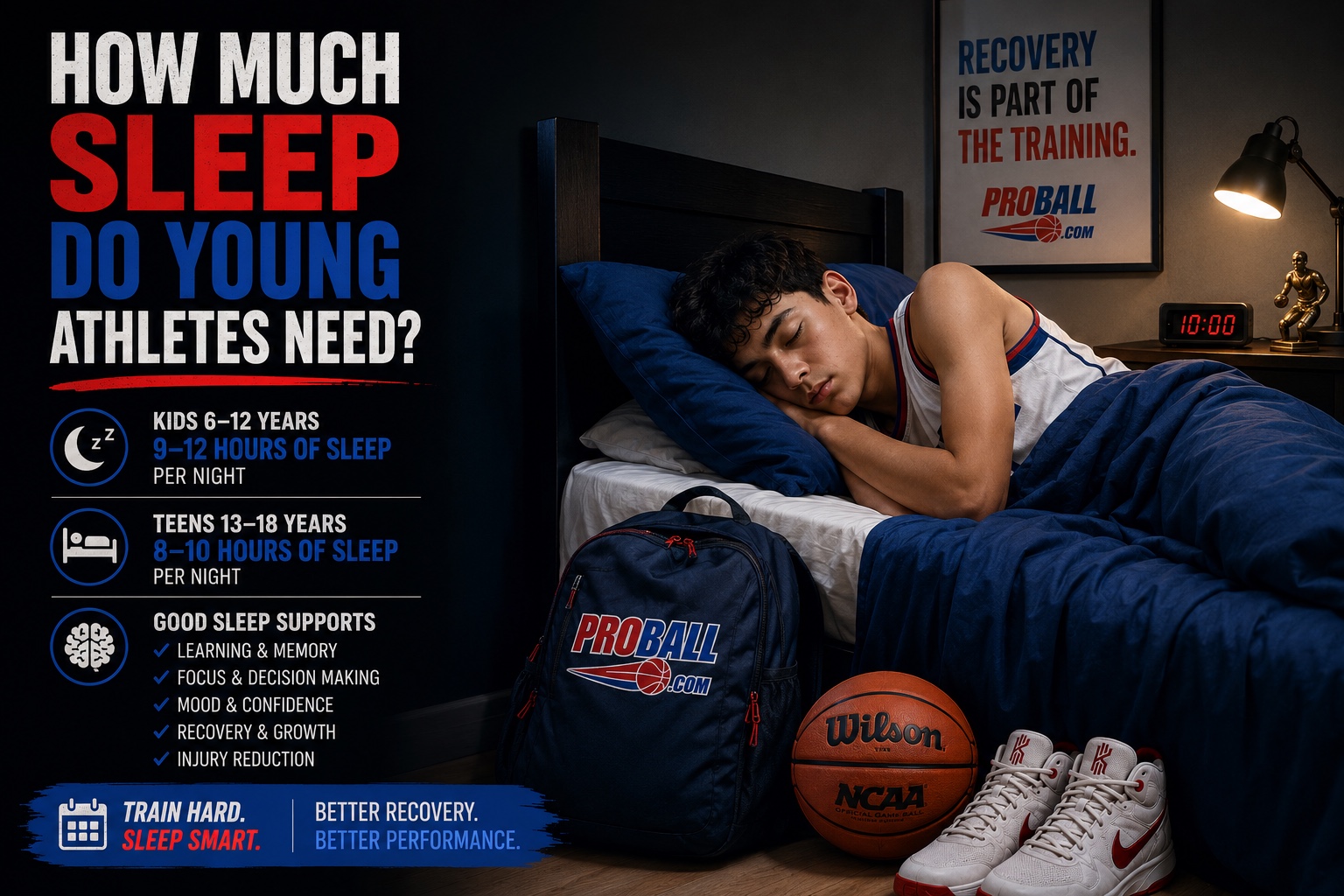
Parents spend a lot of time thinking about training. Should my child train three times a week? Should they practise shooting at home? Should they do strength work? Should they train more before rep trials?
But there’s another part of athletic development that happens when your child isn’t anywhere near a basketball court. They’re asleep. And for young athletes, sleep isn’t just about waking up feeling less tired.
It’s when a huge amount of recovery happens. If your child is training several times a week, playing games, going to school, growing and trying to improve as an athlete, sleep needs to be treated as part of their training. Because your child can’t simply out-train consistently poor sleep.
How Much Sleep Should Young Athletes Get?
There’s no magic number that applies perfectly to every child. Age matters. According to sleep recommendations commonly used by organisations including the American Academy of Sleep Medicine, children aged 6 to 12 should generally get 9 to 12 hours of sleep per 24 hours, while teenagers aged 13 to 18 should generally get 8 to 10 hours. That’s quite a lot. Especially when you actually work backwards from the morning alarm.
Imagine your 10-year-old needs to wake up at 6:00am for school. If you’re aiming for 10 hours of sleep, they need to be asleep around 8:00pm. Not getting ready for bed at 8:00. Not watching something in bed at 8:00. Actually asleep. That’s where the maths gets uncomfortable for a lot of families.
Basketball Training Doesn’t Replace Recovery
Young athletes sometimes fall into the trap of thinking: More training = more improvement. Up to a point, sure. But training creates stress that the body then needs to recover from. That’s why the goal shouldn’t simply be to cram as many basketball sessions as possible into a week.
How Often Should My Child Train Each Week?
The better question is whether your child’s entire week makes sense. Training. Games. School. Homework. Other sports. Downtime. Nutrition. Sleep. All of it counts.
A child training four nights a week but regularly sleeping six hours isn’t necessarily getting ahead of another child training three times and recovering properly. More isn’t automatically better.
What Happens When Young Athletes Don’t Get Enough Sleep?
One bad night’s sleep isn’t going to destroy your child’s basketball development. We’re talking about patterns. When athletes regularly don’t get enough sleep, things can start showing up on the court. They may be slower to react. Their concentration can drop. Decision-making can suffer. Their body may feel heavier. Their effort might fade earlier. And interestingly, sometimes what looks like a basketball problem isn’t really a basketball problem.
A player might look unfocused at training. They might make unusually poor decisions. They might struggle to remember something the coach just explained. They might look flat defensively. Parents naturally think: They need to concentrate more. Maybe. But sometimes they’re simply exhausted.
Sleep Matters for Skill Development Too
Think about what happens during a basketball session. Your child isn’t just exercising. They’re learning. They’re trying to remember footwork. They’re changing their shooting technique. They’re learning defensive positioning. They’re recognising situations. They’re making hundreds of little decisions.
Sleep plays an important role in learning and memory. So if your child wants to become a better shooter, for example, the answer isn’t endlessly adding more shooting sessions. Quality practice matters.
How Do Kids Become Better Shooters?
Then their brain needs an opportunity to recover and consolidate what they’ve practised. Training and recovery aren’t competing with each other. They’re partners.
Tired Players Make Different Decisions
Basketball is incredibly fast. A player catches the ball and might have a fraction of a second to decide: Shoot. Drive. Pass. Fake. Reset. And that’s one reason sleep matters beyond simply having enough energy to run.
Basketball requires constant decision-making. We’ve written before about kids who become hesitant to shoot during games.
Why Is My Child Scared to Shoot?
Confidence and psychology obviously matter there. But imagine asking a tired brain to make those decisions under pressure. Everything becomes harder. The defender feels faster. The decision feels more complicated. Mistakes become more likely.
Fatigue doesn’t automatically cause confidence problems, but good recovery gives young players a much better platform to perform.
What About Injury Risk?
This is another reason parents should pay attention. Research involving adolescent athletes has found associations between insufficient sleep and increased sports injury risk.
That doesn’t mean: Sleep eight hours and your child won’t get injured. Sport doesn’t work like that. Injuries have many causes.
Training load, previous injuries, physical development, strength, movement, contact and plain bad luck can all play a role.
But recovery is still something we can control. And sleep is probably one of the cheapest recovery tools your child has. No expensive recovery boots. No supplements. No fancy gadgets. Just sleep.
Training Harder Before Rep Trials Isn’t Always Better
This becomes particularly important around representative basketball trials. Parents know trials are approaching and understandably want their child prepared. Suddenly the temptation is: Another skills session. Another shooting workout. Another private lesson. Another fitness session. But there’s a point where adding another workout isn’t preparation. It’s just adding fatigue.
How Much Should Kids Train Before Rep Trials?
The weeks before trials should be about arriving prepared, confident and physically ready to compete. Your child doesn’t win rep trials because they squeezed one extra exhausted workout into Thursday night. The work needs to have been done beforehand.
Don’t Forget That Kids Are Still Growing
This gets lost surprisingly easily in competitive youth sport. We’re talking about children. Their bodies are developing. Their brains are developing. They’re dealing with school. They’re navigating friendships. They’re learning how to handle competition. And they’re playing sport on top of all of it.
A young athlete isn’t a miniature professional athlete. That’s why copying an NBA player’s training schedule usually makes absolutely no sense. Even if stories about LeBron James, Roger Federer or other elite athletes sleeping enormous amounts grab our attention, the useful lesson isn’t: Make your 11-year-old sleep like LeBron. It’s simpler. Elite athletes take recovery seriously. Young athletes should too.
Parents Can Work Backwards From the Morning
Here’s probably the easiest thing you can do tonight. Start with the morning. What time does your child need to wake up? Then work backwards. If they need roughly 10 hours and wake at 6:30am, you’re aiming for around 8:30pm asleep. Suddenly bedtime becomes much easier to understand.
And remember that bedtime and sleep time aren’t necessarily the same thing. A child getting into bed at 8:30pm, spending 30 minutes on their phone and eventually falling asleep at 9:15pm isn’t getting the same amount of sleep. You don’t need to turn bedtime into a military operation. You just need to understand the numbers.
Sometimes the Best Training Decision Is Going Home
We’re obviously big believers in basketball training. Kids improve by playing. They improve through repetition. They improve by being coached. They improve by competing. But development isn’t about collecting as many training hours as possible. It’s about putting together enough quality training over months and years. That requires a body that can keep showing up.
Sometimes the smartest thing a young athlete can do isn’t squeeze in another 500 shots. It’s eat dinner. Put the phone away. Go to bed. And come back tomorrow ready to work. Because training ends. Recovery doesn’t.
Want Your Child to Train More Consistently? Book a free trial
At ProBall, young players can train regularly across our Sydney basketball locations while developing their skills, confidence and understanding of the game. But we’re also big believers that development has to make sense for the child. If you’d like your child to experience ProBall, you can start with our 4-week free trial.
Book a Free Trial