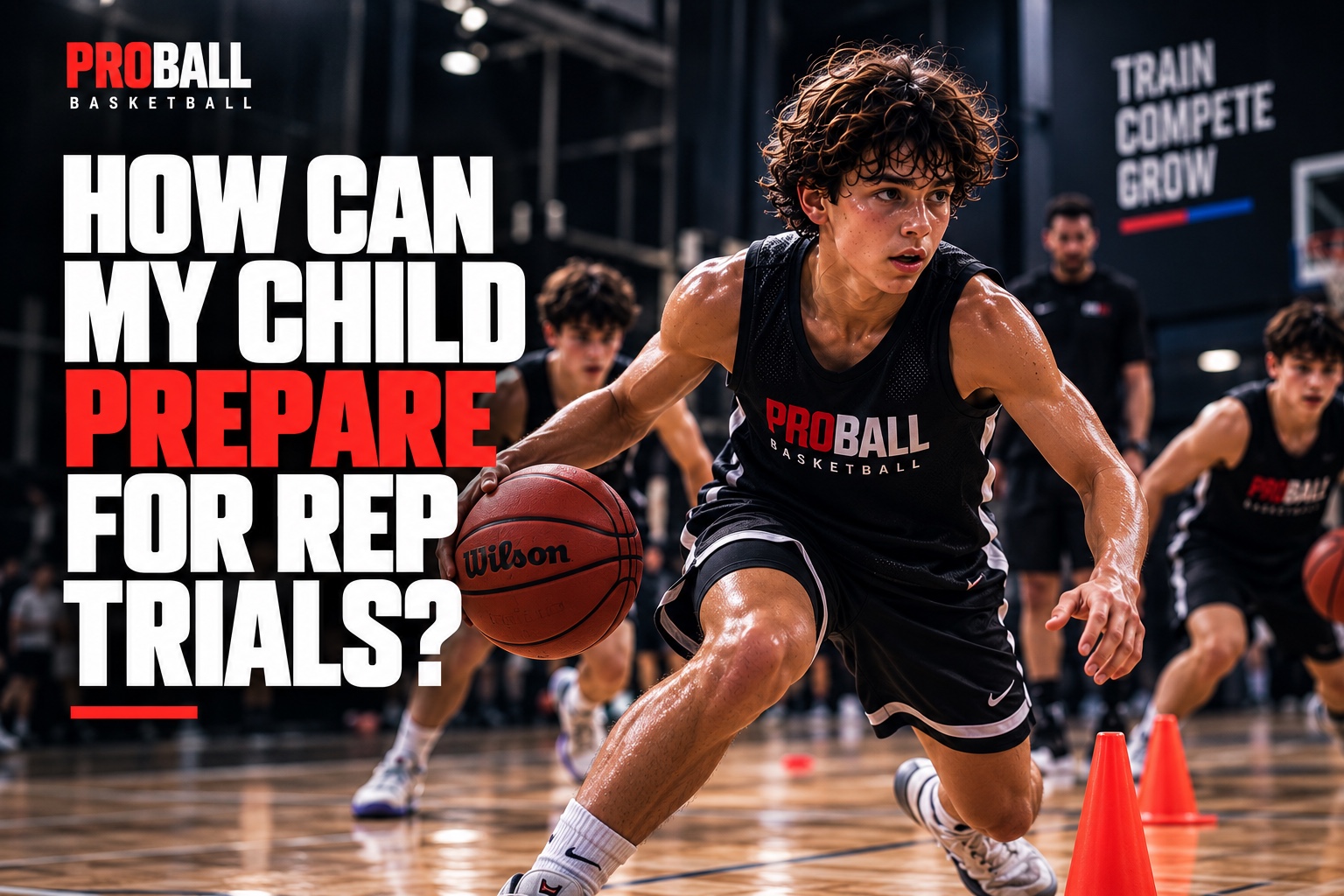
Rep trials have a funny way of making everyone slightly nervous. The player is nervous. The parents are nervous. Sometimes the parents are significantly more nervous than the player, and once trial season gets closer, the same question starts coming up: what should my child actually be doing to prepare? More shooting? More fitness? Private coaching? Extra games? Rep trials?
For young basketball players in Sydney hoping to make a representative team, preparation definitely matters, but preparing properly doesn’t mean trying to completely rebuild your child’s basketball game two weeks before trials.
The best preparation happens much earlier. It’s about giving them enough repetitions, competition and exposure that when trials arrive, the environment doesn’t feel completely unfamiliar. Here’s where we’d start.
First, Understand What Rep Basketball Actually Is
Before preparing for trials, parents and players should understand what they’re trying out for. Representative basketball is a step up from most local junior competitions. There’s usually more training. More travel. Stronger competition. Greater expectations around commitment.
Players are competing for limited roster positions. That doesn’t mean every young basketball player needs to play representative basketball. Far from it.
Although, for a child who loves the game, wants to train more and is looking for a bigger challenge, rep basketball can be a fantastic next step.
Don’t Wait Until Trial Week
This is probably the biggest mistake. Rep trial preparation shouldn’t begin seven days before the trial. A player can certainly sharpen things up before trials, but basketball skills are built through thousands of repetitions over time.
Ball handling. Finishing. Shooting. Passing. Defence. Decision-making. Playing under pressure. You can’t cram those things like a school exam.
If your child is serious about trying out for a representative team, the months before trials matter much more than the final week. That doesn’t mean training like a professional athlete. They’re kids. It means consistency. Two good months of regular basketball beats one frantic week of trying to fix everything.
Get Comfortable Playing Against Good Players
This is huge. A player might look fantastic when they’re the strongest player on the court. Then suddenly they arrive at rep trials and everyone can play. The defenders are quicker. Passing windows disappear faster. Players are stronger. Mistakes get punished. Suddenly the things that normally work don’t work quite as easily.
That’s why one of the best ways to prepare for rep trials is simply spending more time in challenging basketball environments. Play against good defenders. Train with strong players. Compete against older players when appropriate.
Get UNCOMFORTABLE. Yes, we mean that. The goal isn’t to make training easy enough that your child always looks good. The goal is to make the trial environment feel familiar.
Train the Things That Actually Show Up in Games
Young players sometimes prepare for trials by spending enormous amounts of time working on things that look impressive but rarely happen in games.
Rep coaches don’t need every 11-year-old walking into trials with six different step-backs. Build the foundations. Can they dribble with both hands? Can they finish around the basket? Can they make a strong pass? Can they catch and shoot? Can they defend without constantly reaching? Can they play while looking up? Can they make decisions when somebody is guarding them?
Basketball skills become much more valuable when a player can actually use them against defence. So yes, individual skill work matters, but players also need opportunities to play basketball.
Don’t Ignore Defence
This one might not be as exciting as practising threes. Coaches notice defence. A player who competes defensively can influence a trial without scoring ten points. Can they stay in front of the ball? Do they communicate? Do they help teammates? Do they rebound? Do they sprint back after a turnover? Do they stop competing when they get beaten?
That last one matters. Every player gets beaten. The interesting part is what happens next. A young player who gets beaten, recovers and continues competing tells a coach something about them. At a trial where dozens of players are trying to stand out, those little moments matter.
Understand What Coaches Are Actually Watching
One of the biggest misconceptions around rep trials is that coaches are simply counting points. They’re not. Obviously, basketball ability matters, but coaches are trying to build a team, not rank players by how many baskets they score during a trial.
They’re watching how players move without the ball. How they defend. Whether they make good decisions. Whether they pass. Whether they listen. How hard they compete. What happens after they make a mistake. Whether they can contribute when the ball isn’t in their hands.
Sometimes the player desperately trying to prove how good they are actually makes themselves harder to select. They force shots. Over-dribble. Ignore teammates. Try to create something every possession.
Rep trials aren’t an audition for who can touch the basketball the most. Show coaches that you can help a team.
Get Fit by Playing Basketball
Yes, fitness matters. Rep trials can involve repeated drills, games and transitions with limited recovery. Players get tired, and HEAR ME OUT: tired players make different decisions.
Although for young athletes, preparation doesn’t need to become endless running around an oval. Basketball itself provides plenty of conditioning when training is designed properly.
Play. Compete. Defend. Run transition. Train at game speed. Repeat. You want a player capable of continuing to make good basketball decisions when they’re tired. That’s different from simply being able to run for a long time.
Prepare for Mistakes
Your child is going to make mistakes at rep trials. They’ll miss shots. Turn the ball over. Get beaten defensively. Maybe completely mess up a drill while the coach is watching. Welcome to basketball.
The mistake itself usually isn’t the disaster young athletes imagine it is. The reaction can be. A player misses a shot. Head drops. They jog back. Their opponent scores. Now one mistake has become two.
Instead, practise the reset before trials. Mistake. Next play. Miss. Next play. Turnover. Next play. That response is trainable too. Coaches notice it.
Don’t Turn the Car Ride Into Another Coaching Session
Parents can help enormously during rep trials, probably not in the way they think... Your child already has coaches. What they need from you is stability. Try not to spend the drive to trials giving them 14 instructions. Remember to rebound. Make sure you shoot. Don’t turn it over. Stay low on defence. Pass the ball. Be aggressive. Relax. Have fun. Man... even I got tired from writing all this...
By the time they walk into the stadium their brain has 27 tabs open. Keep it simple. Something like: compete hard. Be a good teammate. Enjoy it. Or even only a hug, "I'm proud of you". That's it. Then let them play.
Give Them Enough Repetitions Before Pressure Arrives
Confidence doesn’t magically appear because we tell a young athlete: “Be confident.” Confidence usually comes from evidence. I’ve taken this shot before. I’ve defended players like this before. I’ve trained when I was tired before. I’ve played against good players before. I’ve made mistakes and recovered before.
Preparation matters. The more situations a young player has experienced before trials, the fewer genuinely new situations they encounter during trials. Pressure becomes a little less unfamiliar. When something feels familiar, it becomes easier to trust yourself.
Train Enough, But Don’t Panic-Train
There’s another side to preparation. More isn’t automatically better. If trials are approaching and your child suddenly goes from training twice per week to basketball every single day plus extra running, extra shooting and private sessions, there’s a good chance you’re adding fatigue rather than preparation.
The objective is to arrive at trials:
Sharp.
Confident.
Healthy.
Excited to play.
Not exhausted.
Training volume should build progressively. The weeks and months before trials are where you build. The final few days are not where you attempt to become a completely different basketball player.
The Week Before Rep Trials
As the trial gets closer, simplify things. This isn’t the time to introduce 15 new skills. Keep playing. Keep shooting. Keep touching the basketball. Keep the body moving. Sleep properly. Eat normally. Stay hydrated.
Mainly, avoid turning the trial into the biggest event in your child’s basketball life. It’s an opportunity. That’s all. One trial doesn’t determine how good a basketball player a child can eventually become.
On Trial Day
Arrive with enough time that your child isn’t sprinting through the stadium doors tying their shoes. Bring water. Make sure they’ve eaten. Know where you’re going. Then let them compete.
Your child doesn’t need to be perfect. They don’t need to score the most points. They don’t need to prove their entire basketball future in 90 minutes. They need to show who they are as a player.
Compete. Listen. Defend. Make good decisions. Be a teammate. Move onto the next play. That’s enough.
And If They Don’t Make the Team?
This might be the most important part. Not being selected hurts. Especially when a child has worked hard. Let them be disappointed. But don’t let one selection decision become a verdict on their potential.
Young basketball players develop at wildly different speeds. One player might be ahead physically at 11. Another catches them at 13. Another takes a huge jump at 15. There will always be somebody ahead. There will always be somebody behind. Neither tells you where your child eventually ends up.
If they don’t make it, find out what they need to improve. Then get back to work. Sometimes the best thing a rep trial gives a young player isn’t a jersey. It’s direction.
Rep Trial Preparation Is Really About Making Pressure Familiar
That’s the bigger idea.
You can’t control who else attends the trial.
You can’t control what a coach is looking for.
You can’t control how many positions are available.
But your child can control how prepared they are when they walk through the door.
Give them repetitions.
Give them competition.
Give them challenges.
Give them opportunities to make mistakes.
And give them enough time.
Then when trial day arrives, they don’t need to suddenly become a different player.
They just need to play.
GET REP READY WITH PROBALL
Preparing for representative basketball starts long before trial day. ProBall helps young Sydney basketball players build their skills, confidence and experience through regular training and competitive basketball. New players can start with 4 weeks of free ProBall training.
Book a Free Trial