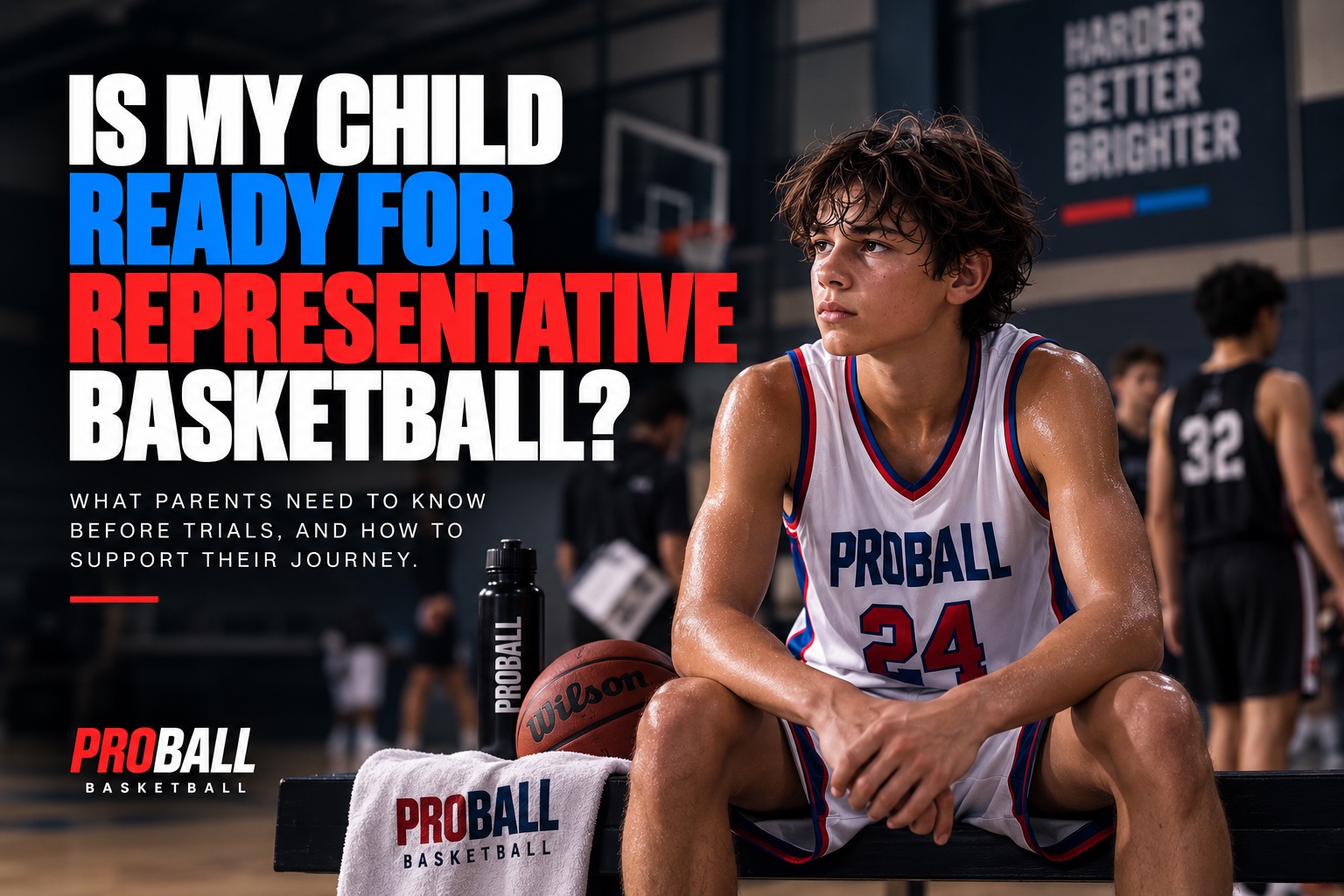
It’s one of the most common questions we hear from basketball parents. “Do you think my child is ready for reps?” Usually, there’s another question hiding underneath it. “Are they good enough?” That’s where we think parents can get representative basketball slightly wrong.
The thing is that being ready for reps isn’t just about being the best player on your local team. It’s not about scoring 20 points every Saturday. It definitely doesn’t mean your child needs to look like the finished product before they even walk into a trial.
Representative basketball is a step up. The game is faster. Players are generally more skilled. Coaches expect more. Training becomes more demanding. Competition for positions increases, but the kids who are ready to explore that environment aren’t necessarily the kids who already dominate everything. Often, they’re simply the kids who are ready to be challenged by it.
First, What Is Representative Basketball?
Representative basketball, usually shortened to “reps”, gives players the opportunity to represent a basketball association and compete against other associations at a higher level than most local competitions.
For many young players, it’s their first experience of a more serious basketball environment. There are trials. Teams are selected. Training expectations increase. Games become more competitive, and suddenly, your child might be surrounded by players who are just as fast, athletic or skilled as they are. That can be uncomfortable. It can also be incredibly valuable.
So How Do You Know If Your Child Is Ready?
There isn’t one test. There’s no magic number of points they need to average, and there’s no age when every basketball player suddenly becomes “rep ready.” Instead, we’d look for a combination of a few things.
1. They Genuinely Enjoy Basketball
This sounds ridiculously obvious. It matters! Representative basketball usually means more training, more games, more travel and more time spent around basketball. If Mum and Dad want reps significantly more than the child does, that can become a problem pretty quickly.
Your child doesn’t need to be basketball obsessed, but there should be some internal motivation. Do they want to practise? Do they talk about basketball? Do they want to improve? Do they ask to play?
When training becomes harder, that internal motivation matters. Eeventually, every young athlete reaches a point where someone else can’t want it for them.
They’re Comfortable With the Basic Skills
Your child doesn’t need an NBA-level crossover. They don’t need perfect shooting mechanics. They don’t need ten different finishes around the basket, but they should be developing a reasonable foundation.
Things like:
- Dribbling under some pressure
- Passing and catching
- Shooting with reasonable technique
- Finishing around the basket
- Defending another player
- Understanding basic spacing
- Making simple decisions during games
Notice the word developing. We’re not looking for perfection. We’re looking for enough of a foundation that the player can enter a faster environment and continue learning.
They Can Handle Being Uncomfortable
This might be more important than parents realise. Imagine your child is one of the strongest players on their current team. Then they walk into a rep trial. Suddenly, there are 50 kids...
Some of them are taller. Some are faster. Some shoot better. Some have already played reps. Your child might barely touch the ball during one drill. They might make mistakes. They might get beaten defensively. They might walk out thinking: "wow. These kids are good.”
That doesn’t necessarily mean they aren’t ready. In fact, learning to operate in that environment is part of becoming ready. A player who can make a mistake, reset and compete again has something incredibly valuable.
They’re Willing to Train
This is where the jump becomes noticeable. As players move into more competitive basketball, natural ability alone becomes less powerful. The gap starts being created by repetitions. Ball handling. Shooting. Finishing. Footwork. Decision-making. Defence. Strength. Movement.
You don’t need to turn an eight-year-old into a professional athlete, but if your child wants to compete at a higher level, they’ll eventually need to become comfortable with practising outside games.
That’s one of the biggest signs we look for. Not: “how good are they right now?” but: “are they willing to work at getting better?”
They Can Listen and Be Coached
Rep coaches aren’t only evaluating basketball ability. They’re also trying to imagine what it’ll be like coaching that player for an entire season. Can the player listen? Can they follow instructions? Can they make an adjustment? Can they stay engaged when they’re not holding the basketball? Can they respond after being corrected?
You can be extremely talented and still make a coach’s job very difficult. Meanwhile, another player might be slightly behind technically but demonstrate great effort, attention and coachability. That matters.
They Don’t Need to Be the Best Player Yet
This is probably the biggest misconception. Parents sometimes wait because they think: “maybe we’ll give it another year until they’re definitely good enough.”
Sometimes that’s sensible, but sometimes the experience itself is valuable. Your child can attend a trial and discover what the next level looks like. They see the speed. They see the skill. They feel the pressure. They discover where they’re currently strong and where they need to improve, even if they don’t make the team, they walk away with information.
That information can completely change the way a young athlete trains. Suddenly: “I want to get better at basketball” becomes: “I need to improve my left hand because I struggled when defenders pressured me.” That’s much more useful.
What If My Child Doesn’t Make the Team?
Then they didn’t make the team. That’s it. It doesn’t need to become something bigger. It doesn’t mean they aren’t talented. It doesn’t mean basketball isn’t for them, and it certainly doesn’t tell you what kind of player they’ll become at 15, 18 or 21.
Youth development isn’t linear. Kids grow at different rates. Confidence changes. Bodies change. Coaching changes. Motivation changes. Skills develop.
Some players stand out incredibly early and get caught later. Others barely get noticed early and suddenly explode a few years down the track. The important part is what happens next.
Can your child hear: “Nnt this time” and keep going? That’s a skill worth developing far beyond basketball.
A Better Question Than “Are They Good Enough?”
Instead of asking:
“Is my child good enough for reps?”
Try asking:
“Would trying reps help my child grow?”
That changes the conversation.
Maybe they make it. Fantastic. Maybe they don’t. They’ve now experienced a higher level and know what they’re working towards. Maybe the trial exposes weaknesses. Good. Now you have something to work on. Maybe they discover they absolutely love competing against stronger players. Even better.
The goal isn’t to protect young athletes from discovering where they currently stand. It’s to give them opportunities to discover where they could go next.
How Should My Child Prepare for Rep Trials?
Don’t suddenly turn the three weeks before trials into basketball boot camp. The best preparation happens well before the trial. Keep training consistently. Work on fundamentals. Play against good competition. Practise making decisions under pressure. Work on both sides of the body. Defend. Improve conditioning gradually.
Perhaps most importantly, help them become comfortable making mistakes while competing.
Trials aren’t usually won by the player trying desperately to prove how good they are on every possession.
Coaches are watching everything. How they defend. How they communicate. How they move without the ball. How they respond to instructions. How they react after mistakes. How hard they compete. Not only this, obviously how well they can play basketball.
One Final Thought for Parents
Your child doesn’t need to have representative basketball figured out before they try representative basketball. That’s backwards.
Sometimes they need to experience the next level before they understand what the next level requires. Let them walk into the gym. Let them feel nervous. Let them compete. Let them discover where they stand. Then help them work on what comes next.
The question isn’t only whether your child is ready for representative basketball today. The more interesting question is: what could they become if they’re willing to keep learning?
Thinking About Rep Basketball? Start Preparing Now.
Whether your child is preparing for their first rep trial or wants to take the next step in their basketball, the best place to start is consistent training. At ProBall, young players can build their skills, confidence and game understanding in an environment designed to keep challenging them as they improve.
Book a Free Trial