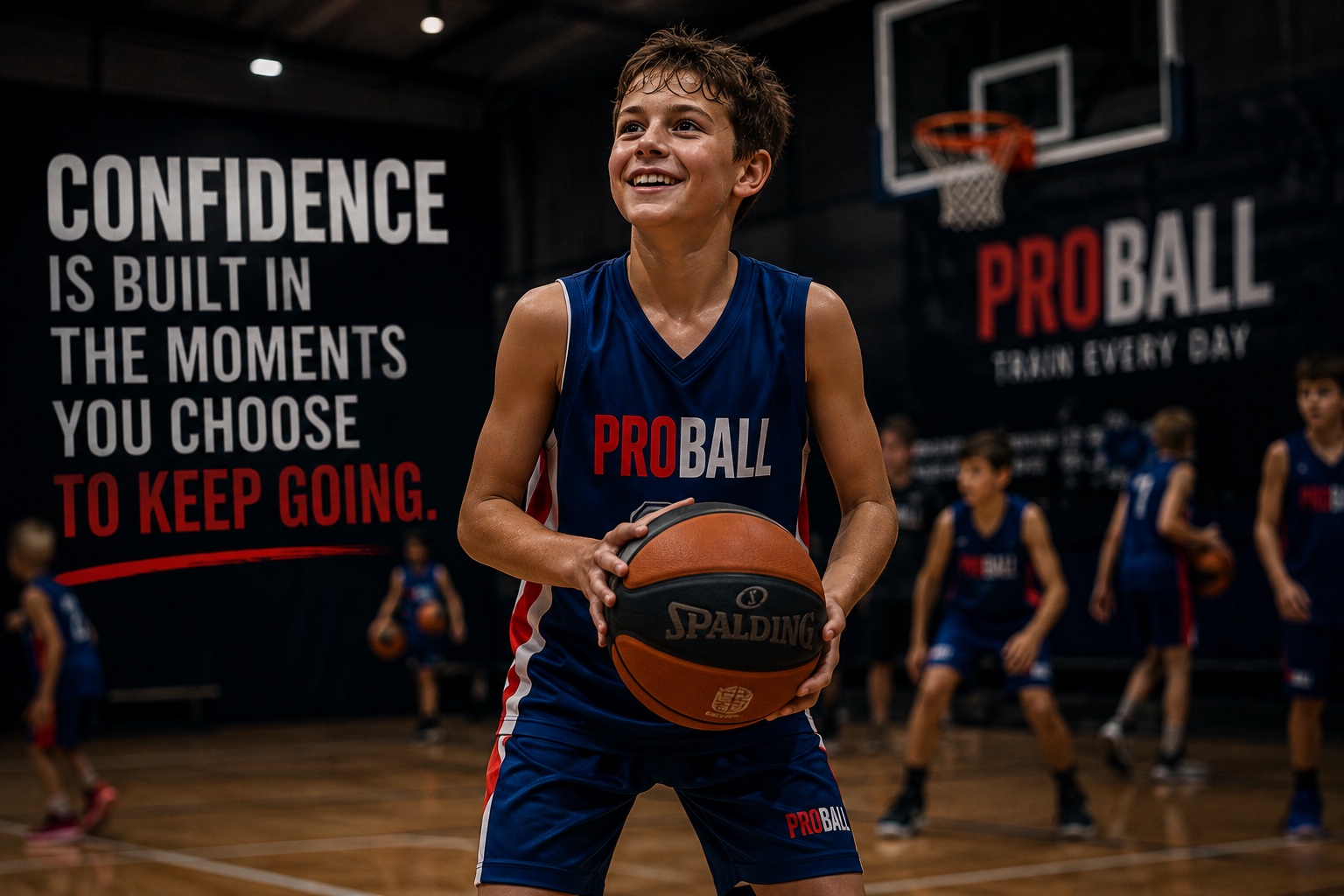
Is Basketball Good for My Child’s Confidence? Yes.
(But probably not for the reason most parents think).
Basketball can be brilliant for a child’s confidence. We’ve watched kids walk into ProBall barely wanting to touch the ball and, months later, call for it in a game.
We’ve seen quiet kids start talking to teammates. We’ve seen kids who were terrified of making mistakes become willing to try things they haven’t mastered yet.
But basketball doesn’t build confidence simply because a child plays it. In fact, basketball can sometimes do the opposite. A child misses five shots. Turns the ball over. Gets beaten by a better player. Loses a game. Suddenly they’re sitting in the car saying: “I’m not good at basketball.”
So how does a sport filled with mistakes, losses and uncomfortable moments actually build confidence? That’s where it gets interesting.
Confidence Doesn’t Come From Always Succeeding
There’s a version of confidence adults sometimes try to give children. We tell them they’re amazing. We protect them from difficult situations. We reassure them immediately when something goes wrong. There’s nothing wrong with encouragement. Kids need it.
On the other hand, the strongest confidence usually comes from something deeper. Evidence. A child struggles with something. They practise it. They struggle again. They keep going. Eventually, they improve.
Their brain now has evidence: “I couldn’t do this before. Now I can.” That’s powerful. Basketball gives kids opportunities to collect that evidence constantly.
This is also why [how often your child trains each week] matters. Confidence grows when kids get enough repetitions to actually see themselves improving.
Think About Learning to Dribble
Imagine a young player who can’t dribble with their left hand. At first, it’s awkward. The ball hits their foot. It rolls across the gym. They lose control when they try to move faster. They might even avoid using their left hand completely because they don’t want anyone seeing them struggle.
Then they practise. Not once. Again and again. Eventually they can walk while dribbling. Then run. Then change direction. Then one Saturday, a defender forces them left. Instead of panicking, they attack.
Nothing spectacular needs to happen. Maybe they simply get past the defender. But something important has changed. The child now knows they can do something they couldn’t do before. That’s how sport can build real confidence.
Basketball Teaches Kids That Mistakes Aren’t the End
Basketball might be one of the worst sports to choose if you’re trying to avoid mistakes. Even great players miss shots. Everyone turns the ball over. Defenders get beaten. Players make bad decisions.
You can play brilliantly for five minutes and then completely forget who you’re supposed to be guarding. The game keeps moving. That’s actually one of basketball’s greatest lessons.
A child eventually learns: I made a mistake, but I’m still playing. They miss. Run back. Defend. Get another possession. Try again.
Over time, mistakes can start feeling less like proof that they’re “bad” and more like something that happens while they’re learning. That mindset can reach far beyond basketball.
We’ve written before about [why some children become scared to shoot], and often the fear isn’t really about shooting. It’s about what they think will happen if they miss.
Being Part of a Team Builds a Different Kind of Confidence
Not all confidence is about basketball ability. For many children, joining a basketball club means walking into a gym full of people they don’t know. New coaches. New teammates. New personalities. That can be intimidating.
Then something happens. Someone remembers their name. A teammate passes them the ball. They start joking during training. They celebrate a teammate’s basket. Eventually, the gym that once felt unfamiliar starts feeling like somewhere they belong.
That’s a huge thing for a child. They aren’t only learning: “I can play basketball.” They’re learning: “I can walk into new environments and find my place.”
Competition Can Build Confidence Too
This one sometimes makes parents nervous. What if my child loses? What if the other players are better? What if they struggle? Those things will probably happen. Believe us, we have seeing it over and over. That’s OKAY.
The goal shouldn’t be to remove every difficult experience from junior sport. The goal is to give children manageable challenges and support them while they work through them. Play someone quicker than you. Guard someone taller. Take the important shot. Play when you’re nervous. Lose a close game. Come back next Saturday. Each experience teaches the child something.
Sometimes the lesson is basketball-related. Sometimes it’s: “That was hard, and I handled it.” That’s confidence.
As players get older, these experiences become especially valuable when they’re [preparing for representative basketball], where pressure and competition naturally increase.
But Basketball Can Hurt Confidence If We Get It Wrong
This matters. Basketball isn’t automatically a confidence-building machine. The environment around the child makes a massive difference.
If every mistake leads to criticism, children can become scared to make mistakes. If parents analyse every possession on the drive home, kids can start believing their performance determines whether adults are happy with them.
If coaches only celebrate the best players, developing players can start feeling like they don’t belong. If winning becomes everything, children can become terrified of failure.
That’s not confidence. That’s anxiety wearing a basketball jersey. Unfortunately, we have had some of that too... The adults around young players have an important job. We need to challenge them without making them afraid to fail.
What Parents Can Do to Help
You don’t need to give your child a motivational speech after every training session. Often, simpler is better. Instead of: “how many points did you score?” Try: “what did you do better today?” Instead of immediately explaining every mistake they made, ask: “What did you learn?”
Praise things they can control:
- Effort
- Courage
- Preparation
- Being a good teammate
- Trying something difficult
- Responding well after a mistake
- Listening to their coach
- Competing when things aren’t going their way
Those behaviours create progress. Progress creates evidence. Evidence creates confidence.
Sometimes Confidence Looks Really Small
Parents often expect confidence to look like swagger. A kid demanding the ball. Scoring 20 points. Celebrating after hitting a three. Sometimes it does.
But we’ve learned to notice the smaller signs too. The kid who finally joins the line without standing behind Mum. The player who attempts the move they’ve been practising. The quiet kid who calls out “ball!” on defence. The child who misses a shot and doesn’t immediately look towards their parents. The player who has a bad game and still wants to come back to training tomorrow.
Those moments might not make the highlights but they’re often where the real development is happening.
So, Is Basketball Good for Your Child’s Confidence?
It absolutely can be. Not because basketball will make everything easy. Because it won’t. Your child will miss shots. They’ll lose games. They’ll meet players who are better than them. They’ll have days where nothing seems to work.
But in the right environment, they’ll also learn something incredibly valuable:
I can struggle at something and get better.
I can make a mistake and keep going.
I can feel nervous and still compete.
I can be part of a team.
I can do hard things.
That’s a much stronger kind of confidence than simply being told you’re good at something. At the end, it’s one of the biggest reasons we believe junior basketball can give kids lessons that stay with them long after they leave the court.
Help Your Child Build Confidence Through Basketball
Give your child the chance to learn basketball, make friends, challenge themselves and build confidence in a supportive environment. Try ProBall with 4 weeks of free training in Sydney and see how they grow.
Book a Free Trial