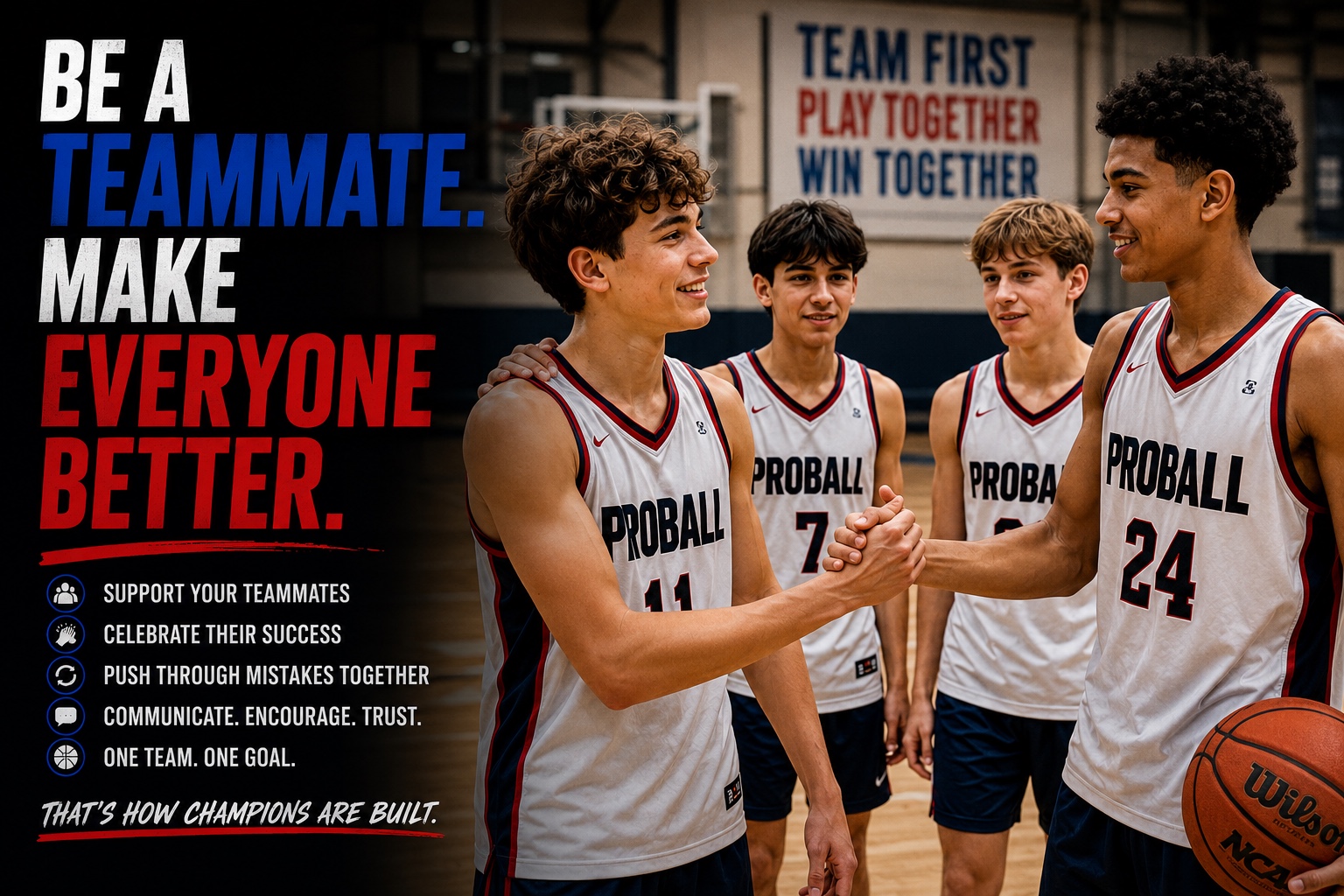
Talent gets attention. Scoring gets attention. Highlights definitely get attention. But there’s another quality coaches notice very quickly, especially when they’re deciding who they trust on the court. What are you like to play with?
Basketball is one of the few sports where five players have to constantly make decisions for each other. You defend together. You communicate together. You share the ball. You cover mistakes. You celebrate success. That means being a good teammate isn’t something separate from becoming a better basketball player. It’s part of becoming one.
Your Teammate Already Knows They Made a Mistake
A teammate misses a wide-open layup. Turns the ball over. Loses their player defensively. Misses two free throws. What happens next?
Young players can sometimes feel the need to point out the mistake immediately. “Come on!” “You had me!” “What are you doing?” But here’s the problem. Your teammate probably already knows.
They don’t need another person reminding them of the mistake while they’re trying to recover from it. What they need is the confidence to make the next play. A high five. “Next one.” “Keep shooting.” “I’ve got you.”
Sometimes nothing needs to be said at all. Great teammates understand that basketball moves quickly. There usually isn’t time to emotionally live inside the previous possession.
Learn to Have a Short Memory
The best teams develop an ability to move on. Not because mistakes don’t matter. Because the next possession matters more. Your teammate misses a shot? Next possession. You turn the ball over? Sprint back. Someone gets beaten defensively? Help them. You miss two shots yourself? Take the right third shot if it’s there.
Players who can reset quickly become easier to trust because one bad moment doesn’t turn into three bad moments.
And there’s another side to this. Your body language affects everybody else. Dropping your head, throwing your hands up, complaining or glaring at a teammate sends a message without saying a word. Your energy already says enough.
Great Teammates Make Other Players More Confident
Think about the teammates you’ve enjoyed playing basketball with. They’re probably not necessarily the highest scorers. They’re often the players who make you feel comfortable playing your game. They communicate. They celebrate your good plays. They don’t destroy your confidence after a mistake. They pass when you’re open. They help defensively. They bring energy when they’re sitting on the bench. They make basketball more enjoyable. That’s incredibly valuable.
Confidence can spread through a basketball team. When players know their teammates have their back, they’re often more willing to play aggressively, communicate and make decisions without constantly worrying about what happens if they mess up.
Being Supportive Doesn’t Mean Ignoring Everything
There’s an important distinction here. Being a good teammate doesn’t mean pretending everything is perfect. Good teammates can hold each other accountable. The difference is how they do it. Instead of: “You never pass.” Try: “I was open in the corner there. Look for me next time.” Instead of attacking the player, talk about the play.
When possible, have difficult conversations privately rather than embarrassing somebody in front of the entire team. And if you’re going to identify a problem, try to help find the solution. Good accountability should make the team better. It shouldn’t make somebody smaller.
Make the Right Basketball Play
Here’s a situation young players encounter constantly. Your teammate has just missed two shots. Next possession, you’re driving toward the basket and the defence collapses. That same teammate is completely open. Do you pass? You should. Not because they’ll definitely make it. Because it’s the right basketball play.
Basketball can’t become a running judgement of who deserves the ball based on what happened during the previous two possessions. If somebody is open, trust them. The irony is that this kind of unselfish basketball often makes everyone better. The ball moves. Defences have to move. Players stay engaged. And suddenly five players become much harder to guard than one.
Coaches Notice This Stuff Too
Young athletes understandably think coaches are mainly evaluating points, shooting and individual skill. They’re watching much more than that. They see who communicates. Who helps someone off the floor. Who encourages teammates from the bench. Who throws their hands up after a bad pass. Who blames somebody after giving up a basket. Who makes the extra pass. Who celebrates when somebody else succeeds.
And especially as players move toward higher levels of basketball, coaches have to ask an important question: Can I trust this player inside a team? Talent matters. But basketball teams aren’t collections of five individual highlight reels. They’re groups of people trying to accomplish something together.
7 Simple Ways Young Players Can Become Better Teammates
Start with these:
- Say “next one” after a teammate makes a mistake.
- Sprint over and help teammates off the floor.
- Celebrate somebody else’s great play.
- Talk positively from the bench.
- Make the extra pass when it’s the right play.
- Communicate on defence.
- Control your body language when things aren’t going your way.
None of these require more talent. Most don’t require additional training. They require awareness. And repetition. Just like shooting or ball handling, being a great teammate is something young athletes can practise.
Be Someone People Love Playing With
Years from now, your teammates probably won’t remember every shot you made. They’ll remember how playing with you felt. Were you selfish? Did you blame people? Did you disappear when things got difficult? Or were you the player who showed up, competed hard and made the people around you better?
Basketball gives young athletes plenty of opportunities to develop skills. But some of the most valuable lessons have very little to do with putting the ball through the hoop.
Talent gets noticed.
Character gets remembered.
And becoming the kind of teammate people want beside them is a pretty good skill to take far beyond basketball.
Want to help your child become a better basketball player?
At ProBall, young athletes don’t just get opportunities to develop their basketball skills. They train, compete and learn how to play as part of a team. Book a Free Trial and experience ProBall basketball training in Sydney.
Book a Free Trial