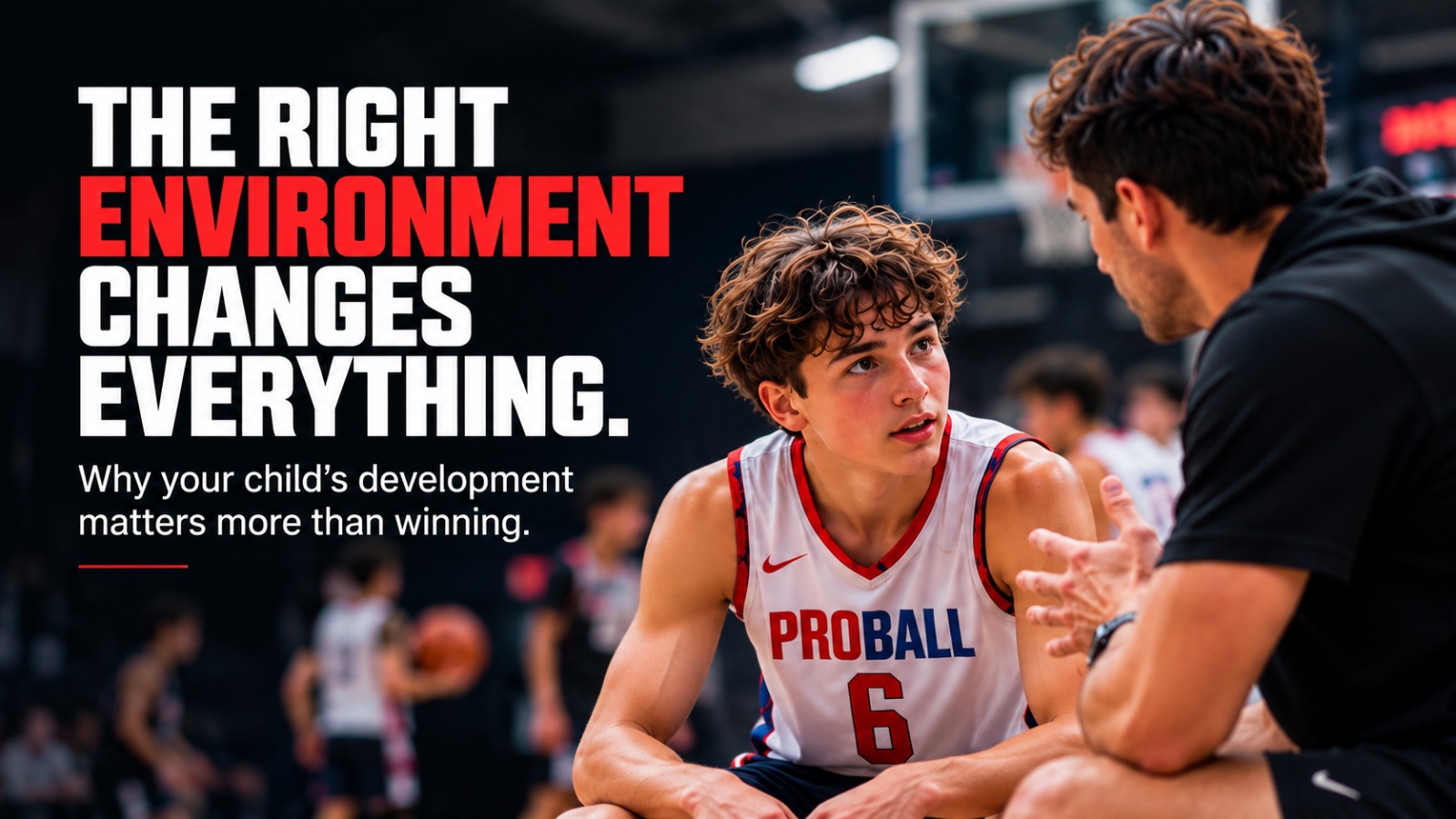
Every parent wants their child to have a great experience playing basketball. They want them to improve, make friends, build confidence and enjoy being part of a team. And naturally, when it comes time to choose a basketball club, parents want to make the right decision.
Although there’s a question that doesn’t get asked nearly enough...
Are you choosing the environment that will help your child develop, or the one that looks the most impressive from the outside?
Because those two things aren’t always the same.
A club might have a fantastic reputation, successful representative teams, impressive facilities and a long history of winning championships. Those are all positive things. But none of them automatically guarantee that your individual child will receive the coaching, opportunities and attention they need to become a better basketball player.
When we’re talking about children who are still learning the game, that distinction matters enormously.
A Winning Basketball Team Doesn’t Always Mean Your Child Is Developing
It’s easy to understand why parents are attracted to successful teams. Winning feels good. Being associated with a strong club feels exciting. And when a team regularly beats its opponents, it’s natural to assume that everyone involved must be improving.
Sometimes that’s absolutely true. Sometimes a team wins because it already has the strongest players.
Imagine a junior basketball team with three exceptionally talented athletes. They’re physically stronger, more experienced and more confident than most of their opponents. They dominate possession, score the majority of the points and help their team win almost every weekend.
Meanwhile, several other players spend most of their time watching. They might receive limited opportunities to handle the ball, make decisions or take important shots. When the game gets close, they’re often the first players substituted.
The team keeps winning, but what is happening to those other children?
A team’s success and an individual player’s development are two different things.
Winning can be part of a fantastic developmental environment. The problem starts when winning becomes so important that young players stop receiving the opportunities they need to improve.
For parents choosing a basketball club, the better question isn’t simply how many games the team wins. It’s whether their child is becoming a better player because they’re part of it.
We’ve seen firsthand why winning isn’t always the best measure of development, including when our younger ProBall teams were challenged by competing against older players.
Don’t Choose a Basketball Club Just Because Everyone Else Is Going There
Junior basketball has its own version of keeping up with the neighbours.
One family moves to a particular club. Another follows. Suddenly, everyone is talking about representative pathways, bigger competitions, more exposure and which organisation has the strongest teams.
Before long, parents can start feeling that unless their child joins a particular club, they’re somehow missing out. That’s where things can get complicated.
A bigger club might offer excellent opportunities. A highly competitive program might be exactly what a particular athlete needs. But the most popular option isn’t automatically the best option for every child.
Consider two 11-year-old basketball players. One has been playing for years, loves competition, handles pressure well and is ready to challenge themselves against stronger opponents.
The other has only recently discovered basketball. They’re improving quickly, but they’re still developing confidence, learning basic decision-making and becoming comfortable making mistakes in games.
Would you automatically put both children in exactly the same environment? Probably not.
One might benefit from a more demanding competitive setting. The other might benefit from more touches, more playing opportunities and a coach who can build their confidence while developing their fundamentals.
Neither pathway is necessarily better. The right basketball environment depends on what the individual child needs at that stage of their development. Those needs will change as they grow.
A Demanding Environment Isn’t Always a Developing Environment
This is one of the biggest misunderstandings in junior sport. Parents sometimes assume that the harder the environment, the better the development. More intense training. Stronger opponents. Tougher coaches. Higher expectations. Surely that must produce better basketball players? Not necessarily...
Children absolutely need challenges. They need to experience losing, make mistakes under pressure, compete against stronger players and discover that improvement requires effort, but there’s a difference between challenging a young athlete and simply making everything difficult.
Imagine a player struggling to finish layups with their weaker hand. In one environment, the coach tells them to work harder. Every time they miss, they receive another reminder that their finishing isn’t good enough.
In another environment, the coach identifies the problem. Maybe the player’s footwork is incorrect. Maybe they’re approaching the basket at the wrong angle. Maybe they’re rushing because they’re worried about getting blocked.
The coach breaks down the skill, provides specific feedback and creates opportunities for the player to practise it. Both environments might have high expectations. Although only one is giving the player a clear pathway to improvement.
Good coaching doesn’t just identify what a player is doing wrong. It teaches them how to get better. That’s what parents should be looking for.
The Best Basketball Coaches Do More Than Demand Effort
Effort matters. Discipline matters. Listening matters. So does being a good teammate. Telling children to try harder isn’t a complete coaching philosophy.
Young players need coaches who can recognise what they’re struggling with and explain how to improve in language they understand.
Sometimes that means correcting shooting mechanics. Sometimes it means teaching a player how to create space without the ball. Other times it means helping a nervous child understand that missing a shot isn’t a reason to stop shooting.
The best coaches understand that children develop at different speeds. They know when to challenge a player, when to encourage them and when to simplify something that isn’t making sense.
They also understand that confidence isn’t built by constantly telling children they’re amazing.
Confidence develops when children experience improvement.
A player who couldn’t dribble comfortably with their left hand three months ago suddenly starts using it during games. A child who used to panic when pressured begins protecting the ball and finding an open teammate. Someone who avoided shooting finally takes an open shot without hesitation.
Those moments might not make the highlights, but they’re often the moments that matter most, and parents should be able to see those changes happening over time.
Watch What Happens After Your Child Makes a Mistake
If you’re considering a basketball club, here’s something worth paying attention to during a training session or game. Watch what happens when a child makes a mistake. Not when they score. Not when they make a great pass. When they do something wrong.
Maybe they miss an easy layup. Throw a bad pass. Forget their defensive assignment. Take a shot the coach doesn’t particularly like. What happens next?
Does the coach explain what the player could do differently? Does the child receive another opportunity to try? Are mistakes treated as part of learning, or does everyone suddenly become afraid of making one?
This doesn’t mean children should never face consequences or receive tough feedback. Sometimes a player needs to sit down, listen and understand why a particular decision wasn’t good enough.
There should be a purpose behind that response. A child who makes a mistake and receives useful feedback has an opportunity to improve. A child who makes a mistake and only learns that mistakes make adults angry might simply become more cautious.
Cautious basketball players often stop experimenting, stop taking opportunities and start worrying more about avoiding errors than learning the game. The environment surrounding a mistake can be just as important as the mistake itself.
Coaches play an important role in how young athletes respond to mistakes, but parents do too. Understanding how to support young athletes through mistakes can make a big difference to their confidence.
Two Basketball Players. The Same Mistake. Two Different Outcomes.
Let’s imagine two young players who miss exactly the same layup during a game. Player One drives towards the basket, gets past their defender and misses an uncontested finish. The coach immediately shouts that they need to concentrate. The player looks embarrassed, starts questioning their ability and becomes reluctant to attack the basket again. The next time they receive the ball, they pass it away.
Player Two misses the same layup. Their coach recognises that the player did several things correctly. They attacked the space, beat their defender and created a high-percentage scoring opportunity. The finish wasn’t good enough, so the coach gives them something specific to work on. Maybe it’s slowing down their final steps or keeping their eyes on the target. The player understands the adjustment and attacks the basket again.
Same mistake. Different coaching response. Potentially very different development over the following months.
Of course, no coach gets every interaction right. Coaches are human, games are emotional and junior basketball can test everyone’s patience. Over time, the pattern matters.
Does your child’s environment make them afraid of mistakes, or does it help them learn from them? That’s a question worth asking.
Playing Time, Repetitions and Opportunities Matter
There’s another important part of choosing the right basketball environment that sometimes gets overlooked. Opportunities. Young players improve by playing basketball. They need repetitions, decisions, challenges and opportunities to apply what they’ve learned.
Training is incredibly valuable, but game experience teaches things that are difficult to replicate perfectly in drills.
A player needs to experience what happens when a defender suddenly closes the space they expected to have. They need to learn when to shoot, when to pass and how to respond when something doesn’t go according to plan. Those decisions become easier through experience.
This doesn’t mean every child must receive identical playing time in every situation. Different competitions, team structures and development pathways have different expectations. Parents should understand what opportunities their child will realistically receive.
If a young player spends most of the season watching from the bench, rarely touches the ball and receives little individual feedback, it’s reasonable to question whether that environment is helping them progress.
On the other hand, a child playing meaningful minutes, making mistakes, receiving coaching and gradually taking on more responsibility might be developing significantly, even if their team isn’t winning every weekend.
The best environment isn’t necessarily the one offering the highest level of competition. It’s the one offering the right balance of challenge, coaching and opportunity.
Sometimes Losing Is Exactly What a Young Basketball Player Needs
Nobody enjoys losing every week. Players get frustrated. Parents get frustrated. Coaches definitely get frustrated. Losing isn’t automatically evidence that a team is in the wrong environment. I wish more parents understood this!
Sometimes young athletes need to compete against opponents who are bigger, stronger, faster or more experienced. At ProBall, we’ve experienced this with younger teams competing against older age groups.
There are games where the physical difference is obvious. Our players have to work harder to create scoring opportunities, defend against bigger opponents and make decisions much faster than they’re used to.
It’s not always comfortable, but when the challenge is appropriate and supported by good coaching, those experiences can accelerate learning.
A player who previously relied on speed might have to develop better footwork. Someone who could score easily against smaller opponents might suddenly need to understand spacing and passing, and a team that once struggled to compete can eventually discover that those difficult games taught them something.
The key is making sure the challenge remains productive. There’s a difference between stretching a child’s ability and placing them in an environment where they’re constantly overwhelmed. A good development program recognises that difference and adjusts accordingly.
Five Questions Parents Should Ask Before Choosing a Basketball Club
If you’re comparing basketball clubs or training programs for your child, don’t make the decision based entirely on reputation, results or what other families are doing.
Ask questions that reveal what the experience will actually look like.
1. How will my child be coached?
Will they receive specific feedback? Are coaches actively teaching skills and decision-making, or mostly organising drills and managing games?
2. Will my child have opportunities to improve?
Consider training frequency, individual development, appropriate competition and opportunities to practise skills during games.
3. What happens when players make mistakes?
Does the program encourage learning, accountability and improvement? Are players given opportunities to apply the feedback they receive?
4. Is the level of competition right for my child?
The strongest competition isn’t always the most useful competition. Your child should be challenged without constantly feeling overwhelmed.
5. Is my child becoming more confident and enjoying basketball?
This one matters more than many parents realise.
A child who enjoys basketball is more likely to keep practising, keep competing and keep coming back.
And over several years, that consistency can make an enormous difference.
The Right Basketball Environment Changes as Your Child Develops
Here’s something else parents should remember.
The basketball environment that’s perfect for your eight-year-old might not be the right environment when they’re fourteen.
At eight, your child might need to develop coordination, confidence, friendships and basic basketball skills.
At eleven, they might benefit from more structured training, stronger competition and learning to make decisions under pressure.
At fourteen, their goals might have changed completely. They may want to pursue representative basketball, improve their physical preparation or take the sport more seriously.
Or they might simply love playing with their friends.
Both are valid.
The important thing is recognising that development isn’t a straight line, and there isn’t one perfect pathway for every athlete.
Some children improve quickly at a young age. Others develop later. Some are physically advanced early, while others need time to grow into their bodies.
A good basketball environment should recognise those differences rather than treating every player as though they’re following exactly the same timeline.
For families considering the next level, understanding whether your child is ready for representative basketball can help you decide what kind of environment they need.
Choosing a Basketball Club in Sydney? Look Beyond the Reputation
Sydney families have plenty of basketball options, from local training programs and domestic competitions to representative pathways and larger basketball associations.
Whether you’re looking at programs in the Inner West, Eastern Suburbs, Inner Sydney or surrounding areas, it’s worth taking the time to understand what each environment actually offers.
Visit a training session. Watch how the coaches interact with the players. Look at whether children are actively involved, whether the training is appropriate for their ability and whether mistakes become teaching opportunities.
Ask how players progress through the program and what opportunities exist as they develop. Most importantly, pay attention to your own child. Do they leave training wanting to come back? Are they learning things they couldn’t do a few months ago? Are they becoming more confident when they play? Those answers will often tell you more than a trophy cabinet.
At ProBall, our approach is built around giving young players opportunities to train regularly, develop their skills and experience different levels of competition as they improve.
We believe young athletes benefit from repetition, good coaching and an environment where they’re encouraged to challenge themselves, but whatever basketball club you choose, those are the things worth looking for.
Your Child Doesn’t Need the Most Impressive Team
They need an environment that helps them grow. One where they’re challenged, but also supported. Where coaches expect effort, but also teach improvement. Where mistakes aren’t ignored, but become opportunities to learn.
They need enough opportunities to practise, compete, make decisions and discover what they’re capable of. They also need parents who understand that a successful junior basketball experience can’t always be measured by the weekend scoreboard.
Years from now, your child probably won’t remember every game their U10 team won, but they’ll remember the coach who believed in them when they were struggling. They’ll remember finally mastering a skill that once seemed impossible. They’ll remember how basketball made them feel.
Choose the environment that develops your child, not the one that impresses other parents.
FIND THE RIGHT BASKETBALL ENVIRONMENT FOR YOUR CHILD
Every young basketball player develops differently. At ProBall, we focus on giving kids the coaching, repetitions and opportunities they need to keep improving, from beginners discovering basketball to experienced players looking for their next challenge. With training across Sydney’s Inner West, Eastern Suburbs and surrounding areas, new players aged 5–15 can come and experience ProBall with 4 weeks of FREE training. Come along, meet our coaches and see whether ProBall is the right environment for your child.
Book a Free Trial