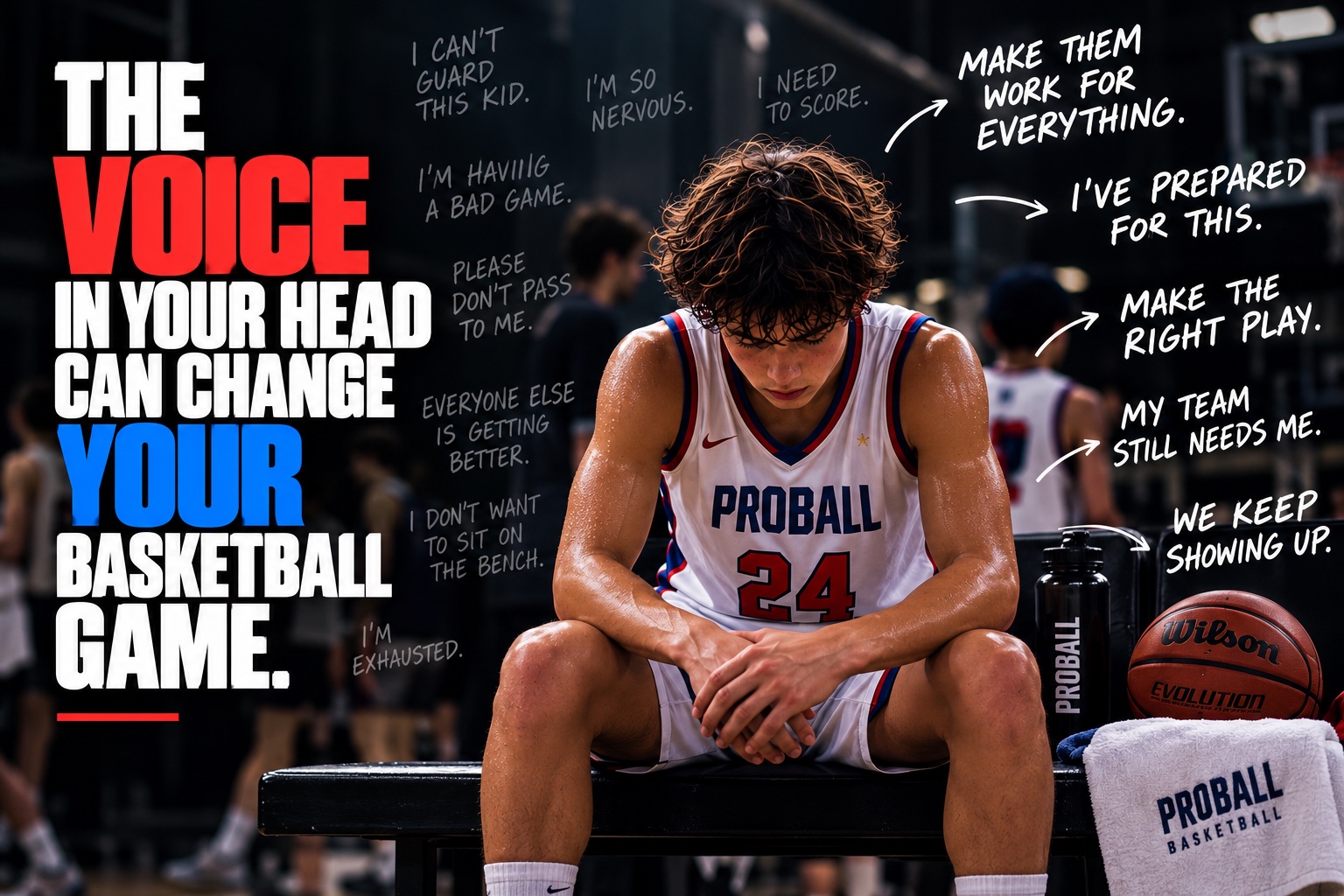
There are two conversations happening during every basketball game. The one everyone can hear, and the one nobody can. That second conversation might be the most important one.
A player gets matched up against someone bigger and thinks: “I can’t guard this kid. They drop a pass: “Please don’t pass to me again.” They’re exhausted: “I’ve got nothing left.” They miss a couple of shots: “I’m having a bad game.” They look around the gym and see players who seem faster, stronger or more skilled: “Everyone else is getting better.”
None of those thoughts are unusual. Young athletes have them all the time. The problem isn’t that the thought appears. The problem is what happens next. One thought can quietly change the way a player competes.
“I can’t guard this kid” becomes backing away. “Please don’t pass to me” becomes hiding from the ball. “I’m having a bad game” becomes dropping their head. “I need to score” becomes forcing shots.
Suddenly, the conversation inside their head is affecting everything happening on the court. Although there’s another option. You can learn to answer yourself.
Your First Thought Doesn’t Have to Be Your Final Thought
We sometimes talk about confidence as though confident athletes simply don’t experience doubt. They do. The difference is that better competitors learn not to automatically believe everything their brain tells them.
Imagine you’re guarding the best player on the other team. Your first thought might genuinely be: “I can’t guard this kid.” Fine. You don’t need to pretend they’re terrible. You don’t need to tell yourself you’re the greatest defender alive either.
Just give yourself something more useful: “Make them work for everything.” Now you’ve got a job. Stay in front. Contest. Sprint back. Make the next possession difficult. That’s a completely different way to compete.
Don’t Try to Eliminate Negative Thoughts
This is where young athletes can get confused about mindset. They think being mentally strong means never being nervous, frustrated or doubtful. That’s impossible. You’re going to get nervous before important games. You’re going to get frustrated when you miss. You’re going to have moments when someone seems better than you. You’re going to get tired.
Mental toughness isn’t pretending those things aren’t happening. It’s learning what to do after they happen. “I’m so nervous.” Can become: “I’ve prepared for this.” Notice that the second statement doesn’t claim you’re not nervous. You might still be nervous, but now your brain also remembers something important. You’ve trained. You’ve taken these shots. You’ve defended these situations. You’ve competed before. Nerves don’t have to disappear before you play.
Replace Judgement With a Job
One of the simplest things we can teach young basketball players is this: when your brain starts judging you, give it a job. Consider the difference. “I’m having a bad game.” That’s a judgement. What are you supposed to do with that?
Now try: “My team still needs me.” That’s different. You can defend. Rebound. Communicate. Set a screen. Sprint back. Encourage a teammate. Make the extra pass.
Basketball gives you another opportunity to contribute almost immediately. A missed shot doesn’t prevent you from playing great defence ten seconds later. A turnover doesn’t prevent you from making the right pass on the next possession. Your previous play and your next play don’t have to be connected.
“I Need to Score” Can Be a Trap
This one catches a lot of young players. They miss a few shots and suddenly decide: “I need to score.” Then they start chasing the game. They take the first shot they see. They drive into three defenders. They stop seeing teammates. They’re trying so hard to fix their performance that they often make it worse.
A better thought is: “Make the right play.” Sometimes that’s shooting. Sometimes it’s passing. Sometimes it’s attacking. Sometimes it’s moving the ball and cutting.
The goal isn’t to prove you’re having a good game. The goal is to make the best basketball decision available. Funny enough, that’s often when the game starts coming back to you.
Confidence Doesn’t Mean Pretending You’re Not Tired
Late in games, another thought appears: “I’m exhausted.” Maybe you are. There’s nothing mentally weak about recognising fatigue. The useful question is what comes next.
Instead of expecting yourself to magically feel fresh: “I’ll give 100% of what I have.” If you’ve only got 60% left, give the team that 60%. Sprint the possession. Talk on defence. Box out. Compete.
Young athletes sometimes think effort means always feeling energetic. It doesn’t. Some of the best effort happens when you don’t feel great at all.
The Bench Is Still Part of the Game
Playing time can create another difficult internal conversation. “I don’t want to sit on the bench.” That’s understandable. Basketball players want to play basketball but sitting down doesn’t mean you’ve stopped being part of the team.
A more useful response is: “I can still help from here.” Talk. Encourage. Watch what’s happening. Notice what the defence is doing. Celebrate teammates. Be ready when your number gets called again.
Coaches notice players who stay connected to the game when they’re not on the court. More importantly, teammates notice too!
Stop Racing Someone Else’s Timeline
Maybe the hardest thought for young athletes is: “Everyone else is getting better.” Because sometimes somebody else is ahead of you. They might be taller. Faster. More skilled. They might make a representative team before you. They might score more points. They might look incredible at 12 years old.
With this being said, basketball development isn’t a race where everybody starts and finishes at exactly the same time. Someone will always be ahead of you. Someone will always be behind you. Neither one is your path.
The comparison that matters most is much closer to home. Are you better than you were six months ago? Are you training? Are you learning? Are you competing? Are you becoming more confident doing things that used to make you uncomfortable? That’s your path. Stay on it.
You Don’t Need Perfect Self-Talk
There’s an important distinction here. We’re not trying to turn young athletes into robots repeating motivational quotes. Sometimes positive self-talk can feel ridiculous. If you’ve missed eight shots, telling yourself: “I’m the greatest shooter in the world!” probably isn’t going to fool your brain...
Useful self-talk should be believable. Short. Specific. Actionable. Next play. Defend. Trust it. Make the right play. My team needs me. I’ve prepared for this.
Those phrases don’t guarantee you’ll make the next shot. They do something more useful. They bring your attention back to something you can control.
The Conversation Nobody Else Hears
Parents hear the crowd. Coaches hear communication. Teammates hear each other. Nobody completely hears the conversation happening inside an athlete’s head. That’s why teaching young players how to respond to their own thoughts matters.
Basketball will give them plenty of opportunities to practise it. A missed shot. A difficult opponent. A bad game. A losing streak. A nervous moment. Someone getting selected ahead of them... Those moments aren’t interruptions to development. They’re part of it.
The goal isn’t to create an athlete who never doubts themselves. It’s to develop an athlete who can hear doubt and still decide what happens next. Because eventually: “I can’t guard this kid.” becomes: “Make them work for everything.”
And that’s the whole point.
BUILD THE PLAYER BEHIND THE GAME
Basketball development isn’t only about shooting, dribbling and passing. Confidence, decision-making, resilience and learning how to compete all matter too. At ProBall, young players can train consistently, challenge themselves and keep building their game in a supportive basketball environment. New players can start with 4 weeks of training free.
Book a Free Trial