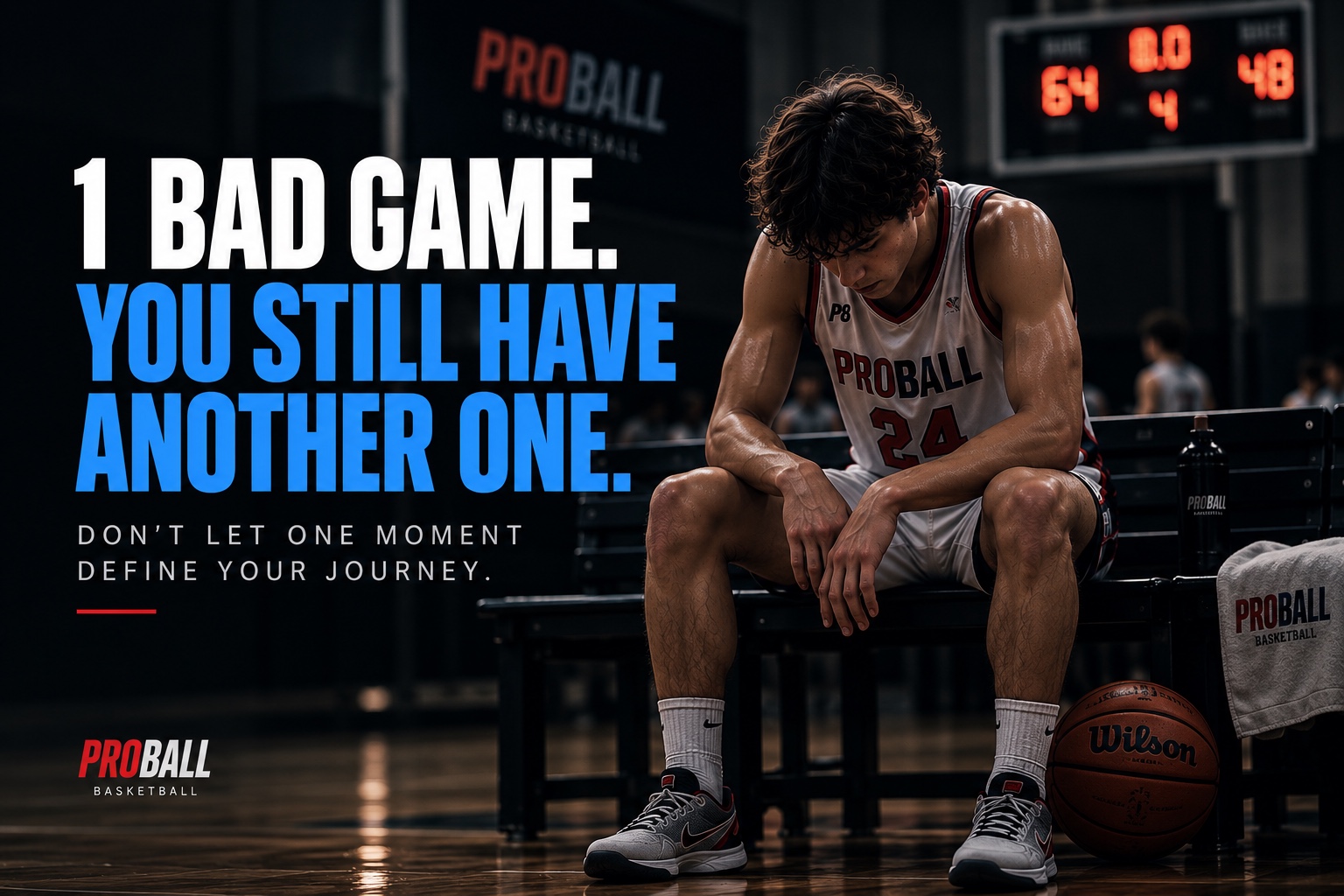
You played badly. Maybe you couldn’t make a shot. Maybe you turned the ball over five times. Maybe your defence wasn’t good enough. Maybe your team lost. Maybe you got benched. Maybe you walked off the court thinking: “I was terrible.”
Fair enough. Sometimes you actually do play badly, but here’s the part young basketball players often struggle to understand: One bad game is one bad game. That’s it. You haven’t suddenly become a bad basketball player.
1 Bad Quarter. You Still Have 3.
Basketball gives you something pretty useful. Another possession. You can miss three shots in the first quarter and still hit the biggest shot of the game in the fourth. You can turn the ball over and sprint back to make a defensive stop. You can get beaten off the dribble and defend the next possession better.
Young players often carry mistakes with them. One bad possession becomes two. Then three. Soon they’re not playing the opponent anymore. They’re playing the mistake that happened five minutes ago.
We’ve talked before about why some young players become scared to shoot. Often it isn’t because they’ve forgotten how to shoot. They’re worried about what another miss might mean. Learning to move onto the next possession is a basketball skill too.
1 Bad Game. You Still Have Another One.
This is where perspective starts becoming important. A bad game feels enormous when you’re sitting in the car immediately afterwards. Especially when you care, but basketball players play hundreds, sometimes thousands, of games over their lives. You’re going to have some shockers. Every player does.
The question isn’t: “will I ever play badly?” You will. The better question is: “what do I do next?” Go back to training. Figure out what went wrong. Work on it. Then play again.
That’s one of the reasons we believe regular basketball training matters for young players. When your entire basketball experience revolves around one game each week, that game can feel enormous. Training gives you somewhere to go next.
1 Bad Week. You Still Have 51.
Sometimes it isn’t just one game. You might have a terrible week. Your shot feels weird. Training isn’t going well. Your confidence disappears. Suddenly everything feels harder than it did seven days ago. That’s normal too.
Improvement in basketball isn’t a straight line. A young player might look incredible one week and completely lost the next. That doesn’t necessarily mean they’re going backwards. They’re learning. Growing. Playing against different opponents. Trying new skills. Getting tired. Making mistakes.
This is also why confidence in basketball shouldn’t depend entirely on results. Real confidence isn’t: “I always play well.” Real confidence is: “even when I don’t play well, I know I can work through it.” That’s a completely different mindset.
1 Bad Month. You Still Have 11.
Now it gets harder. A bad month can feel like forever to a young athlete. Maybe you’re not getting the minutes you want. Maybe other players seem to be improving faster. Maybe you didn’t make the team you wanted. Maybe you’ve stopped enjoying basketball as much because every game feels like another test. This is where patience matters.
Basketball development happens over years, not weeks. That’s especially important for parents to remember. Children grow at different speeds. Their bodies change. Their confidence changes. Their understanding of the game develops.
One player might dominate at 11 and struggle at 14. Another might barely stand out at 11 and become one of the strongest players at 16. You simply don’t know yet.
We’ve seen the same principle when discussing representative basketball. Making or missing a rep team at one particular age doesn’t decide a child’s basketball future. It’s one moment in a much longer journey.
1 Bad Year. You Still Have Your Whole Basketball Journey Ahead of You.
This might be the most important one. Young athletes sometimes think everything happening right now is permanent. It isn’t. Maybe this season wasn’t yours. Maybe you barely won. Maybe you didn’t make reps. Maybe your confidence disappeared. Maybe you weren’t getting much court time. Maybe basketball simply didn’t go the way you hoped. That year still taught you something, and you still get another one.
When we talk about what representative coaches actually look for, talent obviously matters. But so do things like effort, coachability, defence, resilience and how a player responds when things aren’t going their way. Those qualities are often built during difficult periods. Not easy ones.
Parents Need the Long View Too
This message isn’t only for players. It’s for us adults as well. It’s incredibly easy to overreact to what happened on Saturday. Why didn’t they score? Why aren’t they playing more? Why is that kid improving faster? Why didn’t the coach put them on? Why didn’t they make that team?
Sometimes those are fair questions. But zoom out. We’re talking about children. A nine-year-old having a bad basketball season isn’t a basketball emergency. Neither is an 11-year-old missing a rep team. Neither is a 13-year-old going through a confidence slump.
Our job isn’t to make sure their basketball journey contains no disappointment. It’s to help them learn what to do when disappointment arrives. That’s one of the biggest ways basketball can build a child’s confidence. Not by making them feel successful every second. By teaching them: “that didn’t go my way, and I’m still going.”
Don’t Judge the Journey From One Moment
This is the message we want young ProBallers to remember.
1 bad quarter?
You’ve still got three.
1 bad game?
You’ve got another one.
1 bad week?
You’ve got 51.
1 bad month?
You’ve got 11.
1 bad year?
You’ve got your whole basketball journey ahead of you.
Learn from it. Train. Come back. Try again. Then again, and AGAIN. The players who become good aren’t the ones who never have bad days, but the ones who don’t let a bad day convince them to stop.
Give Your Child Somewhere to Keep Getting Better
Bad games happen. What matters is having the right environment to learn, train and come back better. Give your child 4 weeks of free ProBall training in Sydney and let them experience it for themselves.
Book a Free Trial